
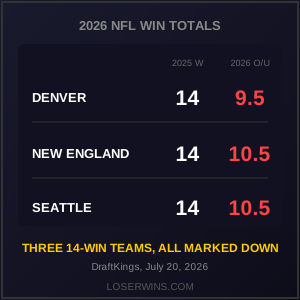
Denver played thirteen games last season decided by eight points or fewer. They won eleven of them. That ties the NFL single-season record for one-score wins, a mark the 2022 Vikings and the 2024 Chiefs reached first. The 2026 NFL win totals now have the Broncos at 9.5 games, four and a half wins below what they actually did.
Denver wasn’t alone at 14-3. New England finished there, and so did Seattle, who went on to beat the Patriots 29-13 in Super Bowl LX. Three teams tied for the best record in football. All three opened this summer well under it, and since May only one of the three numbers has actually moved.
What Denver’s Eleven Wins Measured
Sean Payton has been direct about this. Asked in March about the close-game record, he said he’s “not naive enough” to think some of those wins couldn’t have gone the other way. Coaches don’t often volunteer that a season was partly luck.
The team’s own site supplies the number that makes his point. Before the Week 5 win over Philadelphia, Denver had gone 2-8 in its previous ten one-score games, a stretch running back into the start of 2024. Same building, same head coach, same quarterback for most of it. Then the rest of the year went the other way, right through a Week 17 game against Kansas City that ended as the eleventh one-possession win of the season.
A one-score record is close to the least stable thing a football team produces. It tracks a handful of possessions across seventeen games, which is a sample thin enough that it tells you more about which way the ball bounced than about the roster underneath. Books price that accordingly, which is how a 14-3 team ends up at 9.5.
That reasoning has a limit worth naming. Taking four and a half games off a record is a claim about how much of the record belonged to variance, and the size of the discount is a judgment call rather than a calculation. Nobody has the true number.
Where the Win Totals Moved Since May
DraftKings posted opening figures on May 18, the week the schedule came out. FOX Sports recorded Denver at 9.5, New England at 9.5, and Seattle at 10.5. When Sports Illustrated took a snapshot of the same book on July 20, as camps opened, New England sat at 10.5 and the other two hadn’t budged.
The Patriots number moved a full game, and the price moved with it. In May the over 9.5 cost -140. By July the over 10.5 paid +115. That is a genuine repricing rather than a nudge, and it happened without a snap being played, which is the kind of thing worth watching if you care about line movement as a signal.
Denver went nowhere at all. The number opened 9.5 with -115 on the over and -105 on the under. It now sits -110 both ways. Two months of camp reports, roster churn and schedule analysis, and the book landed on a coin flip.
Seattle Won the Title and Lost the Roster
Seattle’s summer has been rougher than New England’s on paper. Kenneth Walker III, the Super Bowl LX MVP, signed a three-year deal with Kansas City worth $43.05 million with $28.7 million guaranteed. Boye Mafe went to Cincinnati. Coby Bryant went to Chicago. Seattle declined to use the franchise tag on Walker, which set the whole departure in motion.
Their win total held at 10.5 anyway. The juice on the over eased from -130 to -115, which reads as drift rather than a move. A defending champion lost its most recognizable offensive player and the number barely registered it.
That gap is the useful part. New England kept its core and got marked up a full game; Seattle lost a Super Bowl MVP and gave back about a nickel of juice. Whatever the market is pricing, it isn’t name recognition, which tracks with what we wrote in February about how little Walker’s award actually predicted.
The Case Against Fading All Three
Season win totals are a thin market. Books post them months early at low limits, partly to take action and partly to learn where money wants to go. A May number is a first guess that gets corrected in public, which is more or less what New England’s did.
Regression in close games is a tendency across a league rather than a forecast about one club. Some teams follow a lucky year with another one. A defense that keeps games inside a single score is doing something repeatable, even when the win-loss split inside those games is not.
Schedule carries weight too. FOX Sports’ projected difficulty had New England facing one of the league’s easiest slates in 2025 and the sixth-toughest in 2026, and a swing that size moves a win total on its own without any argument about luck. The 2026 NFL win totals reflect both effects at once, and pulling them apart from the outside is guesswork.
This site made the contrarian case for New England as a Super Bowl underdog in February, on the grounds that public money had piled onto Seattle. Seattle won 29-13. Reading a market correctly and reading a football game correctly are separate jobs, and that Sunday was a reminder that the approach we use only claims the first one.
Denver’s 9.5 is priced -110 either way, about as close to a coin flip as the board gets. A team tied an NFL record for winning close games, and the book that watched it happen will now take your money on either side at the same number.