
Champ Week Is Here. Not All Tournaments Are Created Equal.
Conference tournament season tipped off this week with 31 leagues fighting for automatic bids to the 2026 NCAA Tournament. Selection Sunday is March 15. Between now and then, every game matters, and the betting market treats most of these tournaments the same way: favor the top seeds, trust the chalk, move on.
That’s a mistake. The data shows massive variation in how predictable these tournaments actually are. Some conferences hand the trophy to the regular-season champion year after year. Others are contrarian playgrounds where lower seeds routinely crash the party and steal NCAA bids from bubble teams who thought they were safe.
Understanding which tournaments fall into which category can reshape how you think about March.
The Chalk Tournaments: Where Top Seeds Dominate
Across 2023 and 2025, a combined 51 of 63 conference tournaments were won by the No. 1 or No. 2 seed. That sounds like chalk rules everything. But the aggregate hides the real story, because certain conferences are far more predictable than others.
The West Coast Conference leads the way. The top two seeds have met in the WCC championship game in 16 of the past 17 tournaments. In 13 of those 16, it was Gonzaga vs. Saint Mary’s. That’s not a tournament. That’s a scheduled rivalry game with a trophy at the end. Gonzaga has reached the WCC final 28 consecutive years. With this being the Bulldogs’ final WCC season before joining the Pac-12, expect the market to lean heavily on Gonzaga. And honestly, the market is probably right here.
The Missouri Valley tells a similar story despite having no byes to the semifinals. The top two seeds have met in the championship game three straight years and four of the past five. The Ivy League, where only four teams even qualify, has produced a 1-vs-2 title game in five of the past six seasons. Yale has won four of those five.
If you’re looking for underdog value, these aren’t the conferences to find it.
The Chaos Conferences: Where Bid Thieves Are Born
Now for the good stuff.
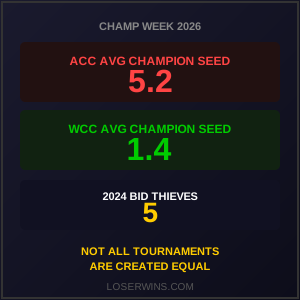
The ACC is the most volatile power conference tournament in the country, and the numbers aren’t subtle. The average seed of the ACC tournament champion over the past five years is 5.2, the highest of any conference. Remember NC State in 2024? The Wolfpack won five games in five days as the 10-seed to become the first double-digit seed to ever win a Power conference tournament. The three years before that produced champions seeded fourth, seventh, and fourth.
The MAAC runs a close second with an average champion seed of 4.6. At least one team seeded fourth or worse has reached the MAAC title game in eight consecutive tournaments. In 2021, the championship was a 9-vs-7 matchup. In 2023, 11-seed Marist won three games to reach the final. The No. 1 seed in the MAAC has lost in the quarterfinals or semifinals in four of the past five years. That’s a complete breakdown of the expected order.
The Sun Belt stands alone in one remarkable stat: the No. 1 seed hasn’t even reached the championship game in any of the past five years. The last time a Sun Belt top seed made the final was 2019. This season’s Sun Belt had a six-way tie for second place at 11-7, which tells you everything about the parity in that conference. Lower seeds in this tournament aren’t just live. They’re historically favored over the chalk.
The CAA has also shifted toward chaos. From 2012 to 2019, every team that reached the CAA final was seeded third or better. Over the past five years, at least one team seeded fourth or worse has made the championship game every single time, including a 6-vs-8 final in 2021 and 12-seed Delaware winning four games to reach the title game in 2025.
Sneaky Upset Spots Worth Watching
Beyond the full-chaos conferences, a few tournaments have specific upset patterns worth watching.
The Southern Conference defies expectations in a predictable way. The champion is usually a top-two seed, but the 2-vs-7 quarterfinal matchup is an annual bloodbath. The 7-seed has beaten the 2-seed in each of the past three years, and five of the past six. The 6-seed has also knocked out the 3-seed in four of six years. If you’re looking at SoCon tournament futures, those early-round matchups are where the value lives.
The Big Ten hasn’t produced a 1-vs-2 championship game in 17 consecutive tournaments, the longest drought in college basketball. The last time it happened was 2007. That doesn’t mean the favorites always lose, but it does mean the path to the final is consistently disrupted.
The A-10 produces a peculiar split: three of the past six champions were No. 1 seeds, and three were No. 6 seeds. Nothing in between. Meanwhile, No. 2 seeds have reached the A-10 title game in seven of the past 11 years and won exactly zero championships. If you’re betting the A-10 tournament, the 2-seed might be the worst value on the board.
What Bid Thieves Mean for Your Bracket
In 2024, five bid thieves crashed the NCAA Tournament. Every bid thief shrinks the at-large pool by one, which means a bubble team that thought it was safely in suddenly finds itself watching Selection Sunday from the couch. The public tends to underestimate this disruption because it’s hard to price. How do you bet on chaos you can’t predict?
You don’t bet on which specific team will steal a bid. You bet on which conferences are likely to produce one. The ACC, MAAC, Sun Belt, CAA, and SoCon have track records that suggest lower seeds will be involved deep into their brackets. The WCC, MVC, and Ivy League almost never surprise anyone.
As Champ Week unfolds over the next 11 days before Selection Sunday, those patterns will matter. The first automatic qualifier gets punched Saturday when the OVC crowns its champion. By March 15, all 31 bids will be settled, and history says at least a few of them will belong to teams nobody expected.
The public prices conference tournaments like the top seed should win. In roughly a third of these leagues, the data says otherwise. That gap between perception and reality is where contrarian value lives.