
Bubble Teams Buckle While Underdogs Play Free
Championship week opened Tuesday with a wave of championship week upsets across all three power conference tournaments. The pattern was unmistakable: the teams everyone expected to win played tight, and the teams with nothing to lose played loose. The ACC, Big 12, and Big Ten all tipped off their tournaments, and lower seeds delivered results that should look familiar to anyone who follows contrarian betting principles.
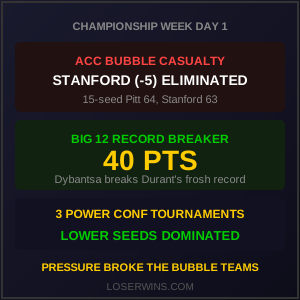
The biggest casualty was Stanford. The Cardinal entered Charlotte as a 5-point favorite over 15th-seeded Pitt, riding a four-game winning streak with their NCAA Tournament hopes on the line. They left with a 64-63 loss after Damarco Minor rebounded his own miss and scored a put-back with 0.7 seconds remaining. A 20-11 team, favored by a touchdown-minus, eliminated by a 12-19 squad that had absolutely nothing to play for beyond pride.
Pressure Played Favorites in Charlotte
Stanford’s loss wasn’t an isolated fluke. All three ACC first-round games went to the lower seed. Wake Forest, the 13th seed, outlasted 12th-seeded Virginia Tech 95-89 in overtime. SMU, seeded 11th, handled 14th-seeded Syracuse 86-69 in a game the Mustangs desperately needed after a late-season losing streak that jeopardized their NCAA Tournament hopes.
The Stanford result stands out because it fits the classic pressure asymmetry dynamic that drives so many conference tournament upsets. Stanford needed the win. Every bracketologist had them squarely on the bubble, and a loss to the worst seed in the tournament likely ends their at-large hopes entirely. That kind of pressure doesn’t motivate teams equally. Sometimes it paralyzes them. Pitt, meanwhile, was already heading home after this week regardless of what happened. They played with the freedom that comes from having zero consequences attached to the outcome.
Dybantsa Broke Kevin Durant’s Record
In Kansas City, the Big 12 Tournament produced its own set of contrarian results, headlined by BYU’s record-breaking demolition of Kansas State. Freshman AJ Dybantsa scored 40 points on 15-of-21 shooting, adding nine rebounds and six assists in a 105-91 victory. The 40 points broke Kevin Durant’s freshman Big 12 Tournament record of 37, set against Kansas in 2007. BYU’s 105 points also set the all-time Big 12 Tournament team scoring record, surpassing Kansas’ 102 against Colorado in 2002.
BYU dropped to the 10th seed through tiebreakers despite being a legitimate NCAA Tournament team. A season-ending knee injury to star guard Richie Saunders had dragged the Cougars into the tournament’s opening round, where they’d normally have earned a bye. The public saw a diminished team playing on the first day. What they missed was Dybantsa’s willingness to carry the entire offense, and a supporting cast that had been quietly adjusting for weeks without Saunders. The Cougars won’t sneak up on anyone from here, but the lesson holds: when the market undervalues a team based on seeding alone, the correction can be swift.
The Big 12 and Big Ten Followed the Script
Elsewhere in the Big 12 first round, 14th-seeded Oklahoma State knocked off 11th-seeded Colorado 92-83. Arizona State, the 12th seed, beat 13th-seeded Baylor 83-79. Cincinnati, seeded ninth, dispatched 16th-seeded Utah 73-66. Three of the four games featured either a lower seed winning outright or a closely contested matchup that defied the bracket’s implied hierarchy.
The Big Ten opened with similar results. 17th-seeded Maryland topped 16th-seeded Oregon 70-60, and 15th-seeded Northwestern handled 18th-seeded Penn State 76-66. These bottom-of-the-bracket games rarely attract public attention or betting volume, but they reinforce the same principle: when two desperate teams meet in a single-elimination game, regular season records become less predictive than contrarian bettors expect the public to believe.
Why Conference Tournaments Reward the Contrarian Mindset
Tuesday’s results preview what the rest of championship week and March Madness will likely deliver. The public gravitates toward teams with better records, higher seeds, and “must-win” narratives. But must-win situations create pressure, and pressure doesn’t always produce better performance. It often produces hesitation, tight shooting, and conservative play.
Stanford shot well enough to win most games. They just couldn’t execute in the final seconds against a team that was swinging freely. Pitt dominated the glass, outrebounding Stanford by a wide margin. That gap tells the story of effort and aggression versus careful, calculated basketball from a team trying not to lose rather than playing to win.
The selection committee will sort out the bubble before Selection Sunday. Stanford’s loss likely pushes them out of the field entirely. SMU survived, but four straight losses heading into the tournament had already raised questions about whether the Mustangs belonged. These are the kinds of results that reshape brackets before the actual bracket is even released, and they tend to create value for contrarian bettors who recognize that public perception lags behind reality.
For bettors watching the conference tournament landscape, the opening day data reinforces a pattern that shows up every March. Seeds are based on regular season results. Tournament games are about matchups, motivation, and which team can handle the moment. Those are different skill sets, and the market often fails to price the difference correctly. The public betting trends that inflate favorites during the regular season become even more pronounced in March, when casual bettors flood the market with name-brand picks and bracket-driven narratives.
Championship week has only just started. Wednesday brings the SEC and Big East openers, plus second-round action across the ACC, Big 12, and Big Ten. If Tuesday was any indication, there’s plenty more chaos ahead before Selection Sunday arrives on March 15.