
Conference Tournaments Start Today. The Public Isn’t Ready.
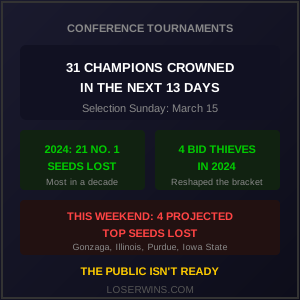
The Horizon League tips off its tournament tonight, and within the next two weeks, all 31 Division I conferences will crown champions. Selection Sunday arrives March 15. Between now and then, the betting public will make the same mistakes it makes every year – overvaluing regular-season champions, ignoring why underdogs feel wrong, and leaving value on the board for anyone paying attention.
Conference tournament season is one of the most underappreciated windows on the college basketball calendar for contrarian bettors. Here’s why.
The Weekend That Proved Nobody Is Safe
Saturday’s results painted the picture in neon. No. 9 Gonzaga lost to Saint Mary’s 70-59 in Moraga, blowing a seven-point halftime lead as the Gaels shot 48% from three in the second half. Illinois, Purdue, and Iowa State – all projected No. 2 seeds entering the weekend – lost within a 48-hour stretch. Even No. 2 Arizona’s 84-61 demolition of No. 14 Kansas, while a dominant performance, required a 19-0 first-half run and a 16-0 second-half run to pull away from a team that had beaten them three weeks earlier.
Four of the top projected seeds in the country lost this past weekend alone. If that kind of volatility happens in regular-season games with no elimination pressure, imagine what conference tournament environments produce.
Why Lower Seeds Have Built-In Edges
Conference tournaments create structural advantages for underdogs that don’t exist in regular-season play. The dynamics are worth understanding because they repeat annually.
First, motivation asymmetry. A team locked into a No. 1 seed in the NCAA Tournament has limited upside from winning its conference tournament. A loss changes almost nothing for a team like Duke (27-2) or Michigan (27-2). But for a bubble team fighting for an at-large bid, every game is survive-or-go-home. That desperation gap matters. In 2024, 21 No. 1 seeds lost in conference tournaments – the most in at least a decade, according to CBS Sports reporting at the time.
Second, familiarity cuts both ways. The betting public assumes the better team wins the rematch, but conference tournament opponents have already played each other at least twice during the regular season. Lower seeds have film, matchup experience, and coaching adjustments that non-conference opponents wouldn’t have. A No. 8 seed that lost to the No. 1 seed by three in February knows exactly what went wrong and has had weeks to prepare.
Third, neutral-site venues flatten home-court advantage. Many conference tournaments are played at neutral locations, which removes the single largest edge regular-season favorites enjoy. Without the home crowd and the comfort of familiar surroundings, spreads that held up all season can suddenly look inflated.
The Bid Thief Factor
Here’s where things get interesting for the broader NCAA Tournament picture. A “bid thief” is a team that wins its conference tournament, wouldn’t have made the NCAA field otherwise, and plays in a league with at least one at-large team. In 2024, there were four bid thieves across college basketball, pushing four bubble teams out of the field entirely.
Bid thieves emerge from conference tournament upsets. A No. 7 seed winning the Sun Belt or a No. 5 seed taking the AAC means a team that “shouldn’t” be in the NCAA Tournament gets an automatic bid, reshuffling the entire bracket. In 2024, NC State became the first double-digit seed to win a Power conference tournament in more than a decade when they captured the ACC title and rode that momentum all the way to the Final Four.
The public doesn’t price this volatility correctly. Casual bettors see the regular-season champion as the obvious tournament favorite. They pile money on the top seeds, inflate the lines, and create opportunities for anyone willing to look at the lower half of the bracket.
The Schedule Matters More Than You Think
Conference tournament brackets are compressed. Teams play on consecutive days, sometimes with less than 24 hours between tip-offs. Historically, this grind has favored the hungrier team over the more talented one. Fatigue affects deeper, more veteran-laden rosters differently than younger teams running on adrenaline.
This year’s schedule runs from today through March 15. The Horizon League starts the proceedings. Mid-major tournaments fill the early part of the week, with power conference tournaments following. The Big Ten championship tips just hours before the Selection Sunday broadcast. Every game between now and then carries elimination pressure that regular-season basketball simply doesn’t have.
What to Watch For
Several conferences have particularly interesting dynamics heading into tournament play this year. The WCC Tournament features what could be the final Gonzaga-Saint Mary’s matchup as conference foes, since the Bulldogs are leaving for the Pac-12 next season. After Saturday’s loss, Gonzaga dropped from the 3-seed conversation, and another stumble in the WCC Tournament could push them to a 4 or 5 seed in the NCAA bracket. That creates potential contrarian value for whoever faces them.
The Big 12 is loaded with volatility. Arizona clinched a share of the regular-season title Saturday, but Kansas, Iowa State, Houston, and Texas Tech have all proven capable of beating anyone on a given night. Kansas handed Arizona its first loss on February 9, then got blown out 84-61 in the rematch. The Jayhawks have lost three of their last five. Are they a dangerous lower seed or a team fading at the wrong time? The market will have to pick a side.
The Big Ten features the most uncertainty. Illinois, Purdue, and Michigan State all lost this past weekend. Iowa is on the bubble. The conference tournament could produce multiple bid thieves or at minimum create wild line movement as teams jockey for NCAA Tournament positioning.
And don’t overlook Miami (Ohio) at 29-0 in the MAC. The RedHawks are the only unbeaten team in Division I but have survived six conference games by one possession or in overtime. Their schedule metrics are modest. If they lose in the MAC Tournament, the committee faces a fascinating decision about whether a one-loss mid-major with a perfect regular season deserves an at-large bid. That uncertainty alone could create mispriced lines throughout their bracket.
The Contrarian Approach
Conference tournament season rewards patience and discipline. The contrarian approach doesn’t mean blindly backing every underdog. It means recognizing when the public is overreacting to regular-season results and underpricing the structural factors that favor lower seeds in tournament environments.
Watch for these signals over the next two weeks: large spreads against teams with nothing to lose, top seeds that have already clinched NCAA bids playing with less intensity, and line movement that suggests sharp money disagrees with the public consensus. The data from February’s chaos – when ranked teams fell at a historic clip – suggests this year’s conference tournament season could be especially volatile.
Selection Sunday is 13 days away. The madness has already started.