
Five Ranked Teams Fell in One Night. March Is Still a Month Away.
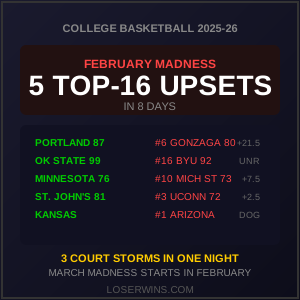
College basketball’s February madness is running ahead of schedule. On a single Wednesday night, February 4, three ranked teams lost to unranked opponents, two fan bases stormed the court, and the AP Top 25 went through a blender. Two days later, St. John’s knocked off No. 3 UConn. By week’s end, No. 1 Arizona had fallen to Kansas. Five top-16 teams went down in the span of eight days. For contrarian bettors, this pattern should look familiar.
The gap between ranked and unranked college basketball teams shrinks every February. Conference play grinds down favorites. Travel, fatigue, and familiarity with opponents create the kind of public blind spots that contrarian bettors learn to recognize. And the betting market, which loves name-brand programs, is often slow to adjust.
Wednesday Night Chaos: Three Upsets, Three Court Storms
February 4 produced a trifecta of upsets that illustrated why February is the most dangerous month for ranked teams.
Portland 87, No. 6 Gonzaga 80. The Pilots entered the game 10-14, losers of three straight, and ranked No. 231 in the NCAA’s NET ratings. Gonzaga was a 21.5-point favorite, riding a 15-game winning streak and undefeated in WCC play. Portland led for all but 32 seconds. Joel Foxwell scored 27 points, the Pilots shot 59.3% from the floor, and the Chiles Center crowd stormed the court after the final buzzer. It was the largest upset in a WCC game in 30 years and Portland’s first win over a top-10 team in program history.
Oklahoma State 99, No. 16 BYU 92. Another court storm in Stillwater, where the Cowboys gashed BYU for 52 points in the paint and 99 total. Anthony Roy poured in 30 points, and even AJ Dybantsa’s 36-point effort couldn’t save the Cougars. BYU committed 16 turnovers and fell for the third straight time. Oklahoma State had lost to Iowa State by 30 at home just weeks earlier.
Minnesota 76, No. 10 Michigan State 73. The Golden Gophers came in at 10-12, losers of seven in a row. They were 7.5-point underdogs. Michigan State never led. Minnesota built a 32-21 halftime advantage and held off a late Spartans surge to snap MSU’s 21-game winning streak against unranked opponents. Another court storm. Fans who had watched seven straight losses suddenly had the biggest win of their season.
The Carnage Kept Coming
Two days later, No. 22 St. John’s beat No. 3 UConn 81-72 at Madison Square Garden, snapping the Huskies’ 18-game winning streak. Zuby Ejiofor had 21 points, 10 rebounds, and seven assists. The Red Storm covered as 2.5-point underdogs and extended their own winning streak to nine.
Then Kansas, playing without star Darryn Peterson, went to No. 1 Arizona and won. The Jayhawks had already been on an eight-game winning streak, but doing it without your best player at the No. 1 team’s home court? That gets the market’s attention.
In the span of one week, the No. 1, No. 3, No. 6, No. 10, and No. 16 teams in the country all lost. Three of those losses came to unranked teams with losing records. If you’re keeping score: five top-16 upsets in eight days, three of them by double-digit underdogs.
Why February Breeds Upsets
This pattern isn’t random, and it repeats almost every year. Several factors converge in February to create contrarian opportunities that the public consistently undervalues.
Conference familiarity cuts both ways. By February, teams have watched enough film on conference opponents to scheme effectively. Coaches at programs like Minnesota and Oklahoma State know exactly what to take away from Michigan State and BYU. The talent gap still exists, but preparation narrows it.
Fatigue compounds across a long season. Top programs play ambitious non-conference schedules, then grind through league play. By mid-February, depth charts are thinner, minor injuries accumulate, and travel takes a toll. Gonzaga had already played 23 games before arriving at Portland’s small gym for a midweek road contest.
Home-court advantage peaks for underdogs with nothing to lose. Portland’s Chiles Center held 3,345 fans who treated a mid-week WCC game like a rivalry. Oklahoma State’s Gallagher-Iba Arena created an atmosphere that had BYU rattled from the opening minutes. When an underdog’s crowd senses opportunity, the energy can be worth more than the spread.
And the market overreacts to team rankings. The AP Top 25 carries psychological weight that distorts public betting behavior. A “No. 6” next to Gonzaga’s name pushes casual bettors toward the favorite, inflating the line beyond what the matchup deserves. Portland’s 21.5-point spread reflected Gonzaga’s ranking as much as the actual gap between these teams on that court, on that night.
What This Means for March
February chaos is a preview of March Madness, not a separate phenomenon. The same forces that produce mid-season upsets accelerate in a single-elimination tournament with neutral-site games and compressed schedules. Teams riding momentum from late-season wins carry confidence into the bracket. Programs that stumble through February sometimes never recover their footing.
Consider what we know heading into Selection Sunday on March 15: Arizona, Michigan, Duke, and UConn are projected as No. 1 seeds. All four have lost at least once this month. The tournament bubble is volatile, with teams like Oklahoma State using February upsets to strengthen at-large resumes. And the public will still overbet chalk when the brackets come out.
History says they’ll be wrong often enough to matter. Since 2010, at least one team seeded fifth or higher has been eliminated in the first round of every single NCAA Tournament. The market knows this, and the lines still don’t fully account for it, because the public can’t resist backing the name on the jersey.
Watching the Spread, Not the Scoreboard
The scoreboard shows Portland beat Gonzaga by seven. The spread tells a different story. Portland covered by 28.5 points against the 21.5-point number. Minnesota, a 7.5-point underdog, won by three — covering by 10.5. St. John’s covered a 2.5-point spread by winning by nine. These weren’t squeakers that happened to go the wrong way for favorites. These were thorough outperformances that the market failed to price.
With conference tournaments beginning in early March and the NCAA Tournament tipping off March 19, the next five weeks offer a window for bettors who pay attention to February’s lessons. The ranked teams that look vulnerable now — BYU has dropped four of five, Michigan State has consecutive losses, Gonzaga showed cracks against a sub-.500 opponent — may carry those vulnerabilities into the postseason.
March Madness starts in March. But February is where the data starts talking. Contrarian bettors are listening.