
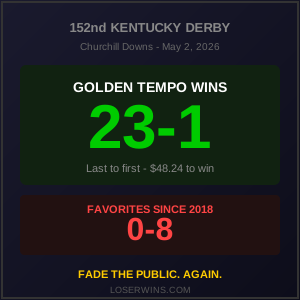
Golden Tempo went off at 23-1, sat dead last for three-quarters of a mile, and won the Kentucky Derby. Saturday’s race was a contrarian’s textbook from gate to wire, and the favorite drought now sits at eight years.
The 152nd Run for the Roses ended in 2:02.27 with Cherie DeVaux becoming the first female trainer in Derby history to saddle a winner. Jose Ortiz rode him, beating his brother Irad aboard Renegade by a nose, after winning the Kentucky Oaks the night before with Always a Runner. The brothers had gone a combined 0-for-19 in this race coming in. Jose got his first Derby win on his 11th attempt.
Last to First on a 23-1 Shot
Golden Tempo wasn’t on most public bettors’ radar. He’d finished third in the Risen Star and third in the Louisiana Derby, scraping into Churchill Downs on points. He went off as the ninth choice in the field. Through the first half-mile, he was at the back of the pack while Six Speed and So Happy set fractions of 22.68 and 46.44. By the three-quarter pole, with The Puma and Great White both scratched and only 18 horses running, Golden Tempo was 18th of 18.
Then Jose Ortiz angled him to the outside. Down the stretch, Golden Tempo passed horses one at a time, drew even with Renegade and Ocelli at the wire, and got the nose. The trifecta paid $11,250.78 on a $1 bet. The superfecta returned $94,489.95. A $2 win ticket on Golden Tempo paid $48.24, per Yahoo Sports’ breakdown of the official Churchill Downs pari-mutuel payouts.
The race went off without the morning-line favorite Renegade ever taking the lead. He ran a strong race from Post 1, the rail nobody had won from since Ferdinand in 1986, and finished a neck away from breaking the streak. He didn’t break it.
Eight Straight Years Without the Favorite
Justify in 2018 was the last betting choice to win the Kentucky Derby. The list since then now reads: Country House (65-1), Authentic (8-1), Mandaloun (26-1, after DQ), Rich Strike (80-1), Mage (15-1), Mystik Dan (18-1), Sovereignty (7-1), and Golden Tempo (23-1). Eight years, zero favorites.
The Derby was, going in, a wide-open race. Renegade, So Happy, and Further Ado all went off at 5-1 as co-favorites. Six horses sat at 9-1 or shorter. That distribution itself was a clue. When the public can’t agree on a favorite, the public is usually wrong about the favorite they do settle on. Renegade got the most attention because of his Arkansas Derby win and his pedigree. He also drew the worst post in the gate.
Todd Pletcher’s drought continued. The Hall of Fame trainer hasn’t won this race since Always Dreaming in 2017, despite saddling more starters than anyone in Derby history. He’s now well past the “2-for-24” line he quoted last year. Bill Mott’s reigning champion stable also missed, with Chief Wallabee finishing fourth. The trainer story this year was DeVaux, who runs a smaller barn and entered with 1,801 career starts before Saturday. Most of those starts didn’t pay $48.24 to win.
Why This Keeps Happening at Churchill Downs
The Kentucky Derby is a different animal than most graded stakes races, and the reasons favorites keep losing don’t seem to be random. A 20-horse field creates traffic problems no amount of class can run through. The pace tends to be honest because nobody can sit comfortably from the rail. Closers with room to swing wide get geometric advantages over horses caught in the middle. And the betting public, which only shows up for one race a year, drives lines on names and storylines instead of trip projections. That gap between what the public buys and what the race rewards is where contrarian value lives.
None of which means a favorite can’t win the Derby again. Trends end. Justify capped a six-year run of favorites winning before the current pattern took over. But after eight years of the same outcome, the betting market has gotten a clear signal about how to handle Derby Saturday, and most of the casual money still ignores it. Golden Tempo had every quality the public reads as “longshot”: modest prep results, no Grade 1 wins, a small-name trainer, an outside post. He had every quality a contrarian recognizes as live: stamina pedigree, late running style, room to make a move, and odds that priced him for failure. The race played out exactly the way underdog value tends to play out when conditions favor it.
Saturday added to a pattern that’s now hard to dismiss. The Derby’s most famous race is also its most fade-the-public race, and Golden Tempo at 23-1 is just the latest entry in a list that gets longer every May.