
The Chalkiest Tournament Ever Just Ended. The Public Learned the Wrong Lesson.
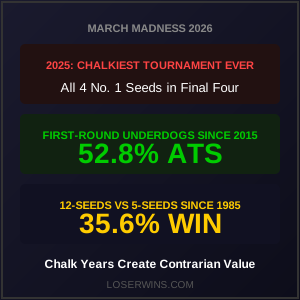
The 2025 NCAA Tournament produced something that had happened only once before in tournament history: all four No. 1 seeds reached the Final Four. Every team seeded 1 through 4 survived the first round without a loss. The entire Sweet 16 consisted of Power Four conference teams. By NCAA’s own upset definition, the tournament produced just four upsets total, tied for the fewest since the field expanded to 64 teams in 1985.
Now the 2026 bracket is set. Duke holds the No. 1 overall seed, joined on the top line by Arizona, Michigan, and defending champion Florida. And the public is about to make a very predictable mistake.
Recency Bias Meets March Madness
After watching chalk dominate for three weeks last spring, casual bettors will flood money toward favorites this week. The logic feels bulletproof: the transfer portal has concentrated talent at the top, parity is dead, and picking upsets is a sucker’s bet. That narrative will drive public betting percentages toward favorites at rates that historically create value on the other side.
But one tournament doesn’t rewrite decades of data. The 2025 bracket was an outlier, not a new baseline. Before last year’s chalk run, a team seeded seventh or worse had reached the Final Four in 13 of the previous 13 tournaments dating back to 2011. The year before that outlier, in 2024, No. 14 Oakland stunned Kentucky. No. 13 Yale beat Auburn. No. 11 NC State ran all the way to the Final Four. Variance works in both directions, and the sport has a long memory of rewarding those who bet against the crowd.
What the Numbers Actually Say About First-Round Underdogs
The historical record still favors taking points in March. According to FOX Sports Research, first-round underdogs have gone 149-133-3 against the spread since 2015, covering at a 52.8% clip. That edge may look modest on paper, but sustained over hundreds of games, it represents a meaningful lean that the betting market has failed to correct.
The 12-over-5 upset remains the sweet spot. Since the field expanded in 1985, 12-seeds have won outright 35.6% of the time against 5-seeds, per the NCAA’s historical database. That’s better than one in three. In 34 of the last 40 tournaments, at least one 12-seed has advanced. The 2025 tournament actually reinforced this trend when McNeese State knocked off Clemson and Colorado State eliminated Memphis.
Even in last year’s historically chalky bracket, the 12-seeds delivered. The underdogs that disappeared were the 13s, 14s, and 15s. One year of that happening doesn’t change the structural reasons why lower seeds compete in March: conference tournament champions arrive with momentum and nothing to lose, while higher seeds carry the weight of public expectations and inflated point spreads.
Where the 2026 Bracket Creates Contrarian Angles
This year’s bracket offers several spots where public perception and actual matchup quality may diverge. Michigan opens as the betting favorite to win the national title at +325, narrowly ahead of No. 1 overall seed Duke at +333. Arizona sits at +425 and Florida, despite being the defending champion, is further back at +600. Those odds will attract massive public handle toward the top of the bracket.
The East Region already looks like a public bettor’s dream lineup, with Duke, UConn, Michigan State, Kansas, and St. John’s all in the same quadrant. When that much name recognition lands in one region, the spreads on their first-round opponents tend to inflate beyond what the matchup data supports. That creates value on the other side for anyone willing to take the points.
Miami of Ohio enters the First Four at 31-1 after going undefeated in the regular season before falling in the MAC Tournament. The committee seeded them as the last at-large team, forcing them into a play-in game against SMU. The Redhawks are underdogs despite that record. If they advance, they’d face Tennessee as a double-digit underdog carrying the kind of us-against-the-world motivation that tends to produce contrarian value in March.
Why Chalk Years Tend to Reverse
History suggests that extremely chalky tournaments are followed by correction. The only comparable year to 2025 was 2008, when all four 1-seeds also reached the Final Four. The following year, in 2009, two of the four 1-seeds were eliminated before the Final Four, and a 3-seed reached the championship weekend. The pendulum swung back.
The reason is partly mathematical regression and partly behavioral. After a chalk year, public confidence in favorites spikes. That pushes more money toward the top seeds, which moves lines further, which creates larger spreads for underdogs to cover. The market overreacts to one year of data while the structural factors that produce upsets remain unchanged: fatigue, pressure, matchup problems, and the raw intensity of teams playing for their tournament lives.
None of this means every underdog will cover this week. What it means is that the 2025 result has primed the public to overvalue favorites at exactly the wrong time. The data over the last decade suggests that first-round underdogs still hold a slight ATS edge, 12-over-5 upsets remain one of the most reliable patterns in sports, and the public betting tendencies that create contrarian value haven’t gone anywhere.
The bracket is set. The First Four tips off Tuesday in Dayton. And somewhere in this 68-team field, a team that nobody believes in is about to prove that March Madness earned its name for a reason.