
McIlroy Survived. The Public’s Favorites Didn’t.
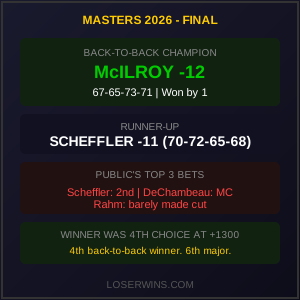
Rory McIlroy won the 2026 Masters at 12-under par, one shot ahead of Scottie Scheffler, becoming only the fourth golfer to win consecutive green jackets. He joins Jack Nicklaus, Nick Faldo, and Tiger Woods. It’s his sixth major championship, tying him with Faldo and Phil Mickelson for the most by a European player in the modern era.
He won ugly. McIlroy blew a record six-shot 36-hole lead on Saturday, shot 73 on Moving Day, then navigated a final round where Justin Rose and Cameron Young each held two-shot leads at various points before fading. McIlroy trailed by as many as three shots on Sunday afternoon. Birdies on 7, 8, 12, and 13 pulled him back in front. He drove into the woods on 18, hacked out to a bunker, chipped on, and two-putted for the victory. It was the least comfortable winning sequence Augusta has seen in years.
For contrarian bettors, the 2026 Masters told a four-day story about how the betting market misprices golf tournaments from start to finish.
How the Odds Board Got Reshuffled
Entering the week, the public’s money landed on three names: Scheffler (+550), DeChambeau (+1000), and Rahm (+950). Those were the top three choices on nearly every board. McIlroy was fourth at +1300.
DeChambeau, BetMGM’s largest liability, missed the cut after two bunker-induced triple bogeys. Rahm barely survived the weekend. Scheffler shot 70-72 through the first two rounds and was 62/1 by Saturday morning before firing back-to-back rounds of 65 and 68 to finish solo second. His bogey-free weekend was the first at the Masters since 1942. But that weekend started 12 strokes behind the leader.
McIlroy, the fourth choice, led after every round and won the tournament. The three golfers the public backed hardest combined for one top-two finish, and it took Scheffler the two best rounds of the week just to get there.
Sunday’s Leaderboard Chaos Was Pure Augusta
The final round produced exactly the kind of back-nine drama that makes the Masters the contrarian bettor’s favorite major. Rose led at 12-under through 10 holes before chunking a chip on the 12th and bogeying. Young tied for the lead early, then gave it back. HaoTong Li, who started the day at 7-under and looked like a Sunday factor, posted a triple bogey on the 12th and a quintuple bogey on the 13th to drop from contention to even par in two holes.
McIlroy’s birdie on the par-3 12th, where he stuck his tee shot to inside seven feet, was only the third birdie at that hole all day in the final round. That shot, more than anything else, won the tournament. It gave him a two-shot cushion entering the final stretch, and even his adventurous drive on 18 couldn’t erase it.
What This Masters Taught Contrarian Bettors
Four lessons from the week at Augusta stand out.
Public money got the podium wrong. The three biggest pre-tournament favorites (Scheffler, DeChambeau, Rahm) finished second, missed the cut, and barely made the weekend. The winner was the fourth choice. In a sport where the public gravitates toward name recognition and recent results, the market consistently overpriced the top of the board.
Longshots delivered value all week. Burns entered at +10000 and finished in the top 10. Reed at +4000 contended through three rounds. Rose at +3000 led on Sunday. The players who know Augusta, who have the specific skill set this course demands, outperformed their odds regardless of where the public ranked them.
The favorite’s odds were wildly mispriced at every stage. McIlroy went from +1300 pre-tournament to -250 after Round 2 to +148 entering Sunday. Scheffler went from +550 to 62/1 to +880. The market kept overreacting to short-term results rather than pricing the full tournament picture.
Augusta punishes overconfidence. McIlroy had a record lead and nearly gave it all away. Rose led on Sunday and couldn’t close. Young looked like a champion on Saturday and wilted under Sunday pressure. The course rewards patience, experience, and the ability to survive bad stretches without compounding mistakes. McIlroy’s final-round 71, full of bogeys and recoveries and one spectacular birdie at the 12th, was the ugliest winning round imaginable. It was also enough.
The green jacket went to a player the public treated as an afterthought behind three bigger names. In the contrarian framework, that’s the whole point.