
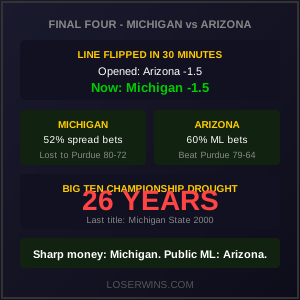
Arizona Opened as the Favorite. The Line Flipped in 30 Minutes.
When Saturday’s semifinal matchup between No. 1 Arizona and No. 1 Michigan first hit the board Sunday night, DraftKings posted Arizona as a 1.5-point favorite. Within 30 minutes, the line jumped the fence. Michigan is now -1.5 and climbing.
That kind of early line movement tells a story. The opening number reflected the oddsmakers’ initial read: Arizona, the tournament’s most dominant team through four rounds, deserved the edge. The quick flip reflected something else entirely. Early money, presumably from sharp bettors who had positions ready, pushed the line toward Michigan before the public even logged in Monday morning.
Now the spread sits at Michigan -1.5, but according to VegasInsider’s early action data, only 52% of spread bets and 56% of the money are on Michigan. That’s a relatively even split for a game where the line has already moved. More telling: on the moneyline, 60% of bets and 63% of the money are on Arizona. The public likes the Wildcats to win straight up, even though the line moved away from them.
For contrarian bettors, this creates a layered situation. The line moved toward Michigan, but the public money leans Arizona on the moneyline. The smart money and the public money may be pulling in different directions. When the opening line and the current line disagree with where the public is betting, the contrarian approach gets complicated. A simple “fade the public” framework falls short here. Both sides have an argument.
Purdue as the Common Opponent
There’s one data point the market can’t ignore. Michigan lost to Purdue 80-72 in the Big Ten Tournament championship game on March 15. Arizona beat Purdue 79-64 in the Elite Eight on March 28. The Wildcats trailed by seven at halftime, then outscored the Boilermakers 48-26 in the second half.
Common opponents are imperfect predictors, and 13 days of tournament basketball separates those two results. But the comparison matters because it addresses the core question: can anyone slow down Michigan’s offense? Purdue did. The Boilermakers held Michigan to 72 points, well below the 90+ the Wolverines posted in every other tournament game. Arizona’s defense, which suffocated that same Purdue team after halftime, ranks among the best remaining. If any team has the blueprint to keep Michigan under 80, Arizona has shown the closest version of it.
The Big Ten’s 26-Year Wait
Michigan and Illinois are in the Final Four together for the fourth time the Big Ten has placed two teams on this stage since 2000. The conference hasn’t won a championship since Michigan State cut down the nets 26 years ago. That’s the longest active drought among power conferences by a wide margin.
The previous three times the Big Ten sent multiple teams to the Final Four this century, the conference came away empty. The last attempt was 2015, when Michigan State and Wisconsin met in the semifinals. Wisconsin won that game but lost to Duke in the championship. Before that, both 2013 (Michigan lost to Louisville in the final) and 2005 (Illinois lost to North Carolina in the final) saw Big Ten teams reach the title game and fall short.
This year’s version might be the conference’s best chance yet. Michigan has been the most dominant team in the tournament by margin, and Illinois has the tournament’s best offense. One of them will reach the championship game. Whether the drought ends depends on navigating Arizona or UConn first.
Transfer Portal vs. Homegrown: Two Models for Building a Champion
The Michigan-Arizona matchup is a referendum on roster construction in the modern era. Four of Michigan’s five starters arrived through the transfer portal. Yaxel Lendeborg, Morez Johnson Jr., Aday Mara, and Elliot Cadeau all played elsewhere before joining Dusty May’s program. May himself is in his second year at Michigan after taking Florida Atlantic to the Final Four in 2023.
Arizona’s model is the opposite. Four of five starters began their careers in Tucson under Tommy Lloyd. The exception, Jaden Bradley, transferred from Alabama but has been a Wildcat for three years. Lloyd has built his program through recruiting and development rather than portal shopping.
From a betting perspective, the transfer-heavy roster raises a question about ceiling versus floor. Michigan’s assembled talent might have the higher peak. Four players from four different programs, all elite, finding chemistry in less than a year, is remarkable. But chemistry built over years, the way Arizona has done it, tends to show up in March when pressure increases and execution matters more than raw talent.
Where the Value Sits Midweek
With three days until tipoff, both Final Four games present contrarian intrigue but limited edges at current numbers.
Michigan -1.5 vs Arizona is nearly a coin flip. The line flip from Arizona to Michigan suggests the sharp side favors the Wolverines. The public moneyline lean toward Arizona suggests casual bettors prefer the Wildcats. When smart money and public money disagree at a spread this small, the result is too close to call from a contrarian standpoint alone.
Illinois -2.5 vs UConn remains the game with clearer contrarian dynamics. UConn is drawing 68% of spread tickets and 69% of the money, making the Huskies the public’s pick. Illinois, as we covered yesterday, has been faded by the public in every tournament game and covered every time. That pattern holds until it doesn’t, but five days into Final Four week, the market hasn’t corrected it yet.
Saturday’s games tip at 6:09 p.m. and 8:49 p.m. ET from Lucas Oil Stadium. Between now and then, watch the Michigan-Arizona line. If it moves to Michigan -2.5 or higher while public moneyline action stays on Arizona, the gap between sharp positioning and public perception will widen. That gap is where contrarian value tends to live.