
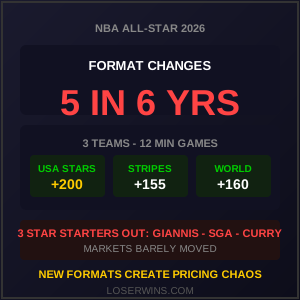
Five Format Changes in Six Years
The NBA can’t stop tinkering with its All-Star Game. Traditional East vs. West lasted through 2017. Then came the captain draft format (2018-2023). Conference teams returned in 2024. A four-team mini-tournament debuted in 2025. And now, for 2026, the league rolls out a USA vs. World round-robin starting Sunday at the Intuit Dome in Los Angeles.
That’s a new format nearly every year, each one accompanied by a new set of betting markets that sportsbooks are pricing with limited historical data. For contrarian bettors, format instability is where value hides. When oddsmakers lack precedent, they lean on name recognition and public perception. Both are unreliable in exhibition settings.
How the 2026 Format Works
Three teams of eight players compete in a round-robin mini-tournament. USA Stars (younger American All-Stars, coached by Detroit’s J.B. Bickerstaff) and USA Stripes (veteran Americans, coached by San Antonio’s Mitch Johnson) represent the domestic talent. Team World (international players, coached by Toronto’s Darko Rajakovic) rounds out the field.
Four 12-minute games make up the tournament. Game 1 pits USA Stars against Team World. The winner faces USA Stripes in Game 2, while the loser plays Stripes in Game 3. After those three round-robin contests, the top two teams by record advance to a championship game. If all three teams finish 1-1, point differential breaks the tie.
Each game lasts just 12 minutes of clock time. Compare that to a standard 48-minute NBA game. Variance skyrockets in small samples, and a single hot shooting stretch can flip a result. That’s the kind of environment where public confidence in favorites often proves misplaced.
Three Stars Missing, Markets Barely Flinch
Giannis Antetokounmpo (calf), Shai Gilgeous-Alexander (abdomen), and Stephen Curry (knee) have all been ruled out. Those are three of the top five vote-getters across both conferences. Their replacements — De’Aaron Fox, Alperen Sengun, and Brandon Ingram — are quality players, but the talent gap is real.
Yet the odds have barely shifted. Team World opened as a slight favorite at most books and remains in that position despite losing Giannis, who was voted as a starter and would have anchored the international roster. The additions of Sengun and Norman Powell (moved from USA Stripes to World to fill roster needs) don’t replace an MVP-caliber player.
When markets don’t adjust to significant roster changes, the public is usually anchoring to the remaining star power — Luka Doncic, Nikola Jokic, and Victor Wembanyama still on Team World feels impressive on paper. But in 12-minute bursts where one player might only see 6-8 minutes of action, individual star power matters less than shooting variance and effort level.
Why Effort Is the Variable Nobody Can Price
Here’s the contrarian angle that matters most: the NBA attached real money to this event. Winners take home $125,000 each, second place gets $50,000, and third place earns $25,000. A $100,000 gap between first and third might seem small for max-contract players, but the competitive structure itself changes behavior.
Last year’s mini-tournament format produced noticeably harder play than recent traditional All-Star Games. Shaq’s OGs defeated Chuck’s Global Stars 41-25 in the championship game, with Stephen Curry earning MVP honors. Players competed. Defense existed. The final score of 41-25 would have been unthinkable in the low-effort exhibitions of 2022 or 2023.
The problem for bettors: effort is uneven and unpredictable. Some players are nursing minor injuries heading into the break. Others want to showcase themselves. Veterans like LeBron James and Kevin Durant (both on USA Stripes) might coast in round-robin games and flip a switch for the championship. Younger players on USA Stars, including Anthony Edwards and Cade Cunningham, might play with more urgency from the opening tip.
USA Stars: the Overlooked Squad
Of the three teams, USA Stars sits as the longest shot at +200 on most books. The roster skews young — Cunningham, Edwards, Maxey, Scottie Barnes, Jalen Johnson, Donovan Mitchell, Kawhi Leonard, and Devin Booker. Bickerstaff coaches a Pistons team that leads the Eastern Conference, which suggests organizational competence in game planning.
Consider what “young” means in an exhibition setting. These players have less mileage on their legs mid-season. They’re more likely to treat a nationally televised showcase as an audition. Several are first-time or second-time All-Stars with something to prove. Mitchell and Booker in particular are elite scorers who can fill it up in a hurry during a 12-minute window.
The public tends to gravitate toward rosters with the most recognizable names. Team World has Jokic, Doncic, and Wembanyama. USA Stripes has LeBron, Durant, and James Harden. USA Stars has fewer household names to casual fans, even though the collective talent level is comparable. That perception gap is where contrarian opportunities tend to emerge.
What 2025 Taught Us (and What It Didn’t)
The 2025 All-Star format produced better basketball but disappointing TV numbers. Viewership hit 4.7 million, down 13% from the 2024 game and the second-lowest figure on record behind the 2023 edition. The new format drew criticism for excessive broadcast filler between short games.
From a betting standpoint, though, the 2025 tournament revealed something useful: the play-to-40 scoring system made outcomes volatile. Teams could fall behind quickly and never recover because there was no clock to manage. The 2026 format uses standard 12-minute timed games instead, which theoretically allows for more comeback potential and closer margins.
Timed games also create a different late-game dynamic. If a team trails by 3 with a minute left, they can deploy intentional fouling and three-point shooting just like a regular game. That favors underdogs. In play-to-40, a trailing team had no mechanism to slow the opponent down.
The Contrarian Takeaway
New formats create pricing inefficiency. The NBA’s All-Star betting market has almost zero historical precedent for a three-team round-robin with 12-minute games. Oddsmakers are essentially guessing, informed by roster talent but unable to account for effort distribution, coaching strategy in micro-games, or the randomness inherent in such small sample sizes.
When bookmakers guess, they default to name recognition. The public follows suit. And when both sides anchor to the same incomplete information, the least popular option tends to carry the most overlooked value.
Whether that’s USA Stars at +200, a specific game underdog in the round-robin, or simply the “under” in these shorter contests, the principle holds: uncertainty favors the contrarian. The NBA’s format experiment might not produce great television. But it could produce exactly the kind of market confusion where patient bettors find an edge.