
Arizona and Carolina meet in Canton on Thursday night to open the preseason, and the NFL preseason betting trends are already making their annual rounds. Underdogs of one to three points covering at 60 percent since 2015. Road underdogs of 2.5 or less sitting at 75-38 against the spread over the last decade. Coach-by-coach ledgers run back more than a dozen years, and the whole set shows up every August carrying the confidence of a settled result.
Most of them come from one place. Covers published the set in late July, and Yahoo Sports runs the identical text under its own banner, which gives you two bylines and a single source.
Where NFL Preseason Betting Trends Come From
The list runs well past those two headline splits. Dan Quinn’s teams are 7-17-1 against the spread in exhibition games across two head coaching jobs, and Washington has gone 3-7 in its last ten preseason home games. Sean McDermott sits at 15-10, and totals cluster around 37 points. None of it is offered as speculation.
The Harbaugh entry is the one to sit with. John Harbaugh is 42-21 against the spread in August, all of it compiled over eighteen seasons in Baltimore, and Covers offers the figure as something to weigh when handicapping New York this month. The Giants hired him in January. His roster changed and so did his coaching staff, and the number came along regardless. Covers does attach a caution here, which is the part readers skip: books have adjusted and lines have moved with them, so the record should be read as a historical baseline rather than something to act on. That sentence is doing more work than the percentages around it.
How a Seven-Game Split Becomes a Finding
A picks site put out something more revealing in July: a top-100 ranking of preseason betting systems built from splits between 2002 and 2025, with companion pages for individual franchises. Jacksonville turns up at 6-1 against the spread in one filter. That is seven games. Chicago appears at 13-3-1 in another, which is seventeen, and San Francisco at 12-5-2, which is nineteen.
None of those records is invented. They are the top of a search. Slice twenty-four preseasons by team, home or road, favorite or underdog, week number and spread range, and you generate thousands of splits. Nearly all are small. Sort by cover rate, publish the best hundred, and the list looks impressive whether or not anything real sits underneath. The pages seem to know it. Each signs off with the same line calling itself a screening condition rather than a bet. That is the gambler’s fallacy pointed the other way, a short run of results read as a property of the world.
ESPN Counted the Perfect Preseasons
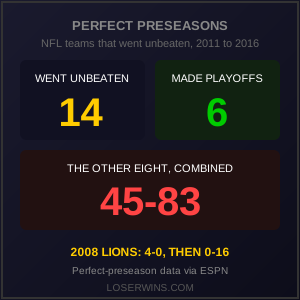
Somebody has checked whether August results carry information into September. ESPN went through the teams that finished the preseason unbeaten and found fourteen of them between 2011 and 2016. Six made the playoffs. The other eight went a combined 45-83, fewer than six wins apiece. Widen the window back to 2002 and fourteen perfect-preseason teams reached the postseason while sixteen did not.
Detroit supplies the extreme case. The 2008 Lions went 4-0 in the preseason, outscored their opponents 80-32, held every one of them to ten points or fewer, and finished with a 14-6 win over Buffalo on August 28. They then lost all sixteen regular season games, the first NFL team ever to do that. Offensive coordinator Jim Colletto told ESPN afterward that the record “didn’t mean squat diddly” to anyone who understood pro football.
That same piece was written during the 2017 preseason and listed the four clubs unbeaten at the time: Baltimore, Cleveland, Denver and Seattle. Cleveland finished 0-16.
August Is Soft, Which Is a Different Claim
None of this makes preseason markets efficient. They plainly are not, and the people posting the numbers will tell you so. Limits sit far below regular season levels because books know they are guessing at rotations, and ESPN has reported spreads in August moving by as much as five points once information gets loose. A former MGM book director told Sports Handle in 2019 that in his whole career nobody had asked to put fifty thousand dollars on an exhibition game, and that he would have called security if anyone tried.
So August does carry information. It comes from depth charts, injury reports, and a coach mentioning on Tuesday that his starters will play one series and sit. That is reporting, and it moves numbers quickly, which describes how line movement works rather than making a case for a backtest. A soft market and a reliable trend are separate claims, and only one of them has been tested against what happened next.
The generous reading of the 60 percent figure is that it was true and is now spent. If small preseason underdogs really did cover at that rate from 2015 onward, books had a decade to notice, and Covers says they have. A pattern that worked until somebody published it has a normal life cycle rather than a scandal attached.
What to Do With a Trend List on Thursday
Check the denominator before the percentage. A record built on fewer than thirty games tells you very little, and most of the eye-catching splits are built on far fewer than that. Ask what else was tested to produce the one you are being shown. Then ask whether the pattern has a mechanism behind it, because a coach who rests everyone is a reason and a franchise that covers in week two is not.
Base rates are the useful starting point, which is why we keep a page on underdog win rates by sport. Preseason is the stretch of calendar where the base rate is close to all anyone has. Volume suggests most bettors already treat it that way. Legal Sports Report cited bet365 figures from 2024 showing an ordinary Cardinals and Cubs baseball game drawing more than four times as many bets as that year’s Hall of Fame Game.
Arizona and Carolina will put rosters on the field in Canton that mostly will not exist by September. Whatever number the game closes at, the result lands in somebody’s database. Next August it will be one of the NFL preseason betting trends.