
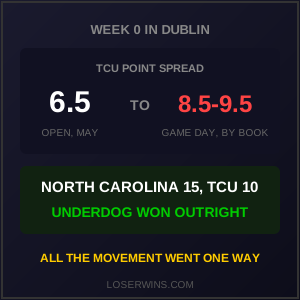
Carolina 15, TCU 10. The North Carolina TCU upset was the first Bowl Subdivision result of the 2026 season, and it ran against four months of line movement pointing the other way. TCU opened at 6.5 back in May, and by Saturday morning in Dublin the Horned Frogs were laying somewhere between 8.5 and 9.5 depending on the book.
We wrote about this game on August 25. That post argued the heavy public money on TCU probably wasn’t a fade signal worth acting on.
The read missed.
Forty-Nine Minutes Without a Point
TCU scored on its first two possessions and then stopped. Kyle Lemmermann answered a Carolina field goal with one of his own, and a two-yard Jon Denman run put TCU up 10-3 in the opening quarter. That was the last time the Horned Frogs put anything on the board. Carolina held them scoreless for the final 49 minutes, per the school’s official recap.
Jaylen McGill tied it at 10 with a nine-yard run before the quarter ran out. The lead flipped late in the half on a botched punt snap, when the ball sailed over the TCU punter’s head and he kicked it out the back of the end zone rather than surrender a touchdown. Two points, 12-10, and Carolina never trailed again. Melkart Abou Jaoude stripped Jaden Craig four minutes into the third quarter, Jaylen Harvey fell on it at the TCU 31, and Aeron Burrell’s 28-yard field goal built the final margin.
Twice after that the Tar Heels had to hold, and twice they did. They stuffed Jeremy Payne on fourth down at their own five, then broke up a fourth-down throw at the 10 with 4:05 left to end a TCU drive that had eaten 15 plays and 7:53 of clock. Billy Edwards Jr. finished 16 of 28 for 232 yards without a touchdown pass, a strange line for a winning quarterback. TCU was flagged 11 times. Going into Saturday the Horned Frogs had scored at least 28 points in 30 straight non-conference regular season games, a run both schools called the second longest by a Bowl Subdivision team in 45 years.
The Number Kept Climbing
TheSpread.com put the opener at TCU -6.5 back in May. Our post on August 25 cited VegasInsider’s read of BetMGM at 7.5, and by game day CBS Sports listed 8.5 while Yahoo Sports had 9.5 at kickoff. Two to three points of drift toward the favorite, all of it in one direction.
Then the favorite lost outright. Carolina covered by roughly 14 in the same matchup where it missed by 30.5 last September, when TCU won 48-14 in Chapel Hill as a 3.5-point favorite. Put those together and the spread result swung about 44 points across two meetings a year apart.
Where the North Carolina TCU Upset Leaves Our Read
The argument last week went like this. The line had moved from 6.5 to 7.5, toward the crowd. Money that pushes a number is money the book respects. Nothing separated the ticket count from the dollar count, so the 92 percent had nothing to point at.
Half of that survives Saturday. Movement toward heavy public action usually does mean the book has seen size it likes, and one August game doesn’t shift a base rate built over many seasons.
The other half rested on a stale input. Our 92-94 split came from a window ten days out, when almost nobody had bet the game, and the board looked different by the weekend. DraftKings’ own splits page on Saturday showed 84 percent of moneyline tickets on TCU against 62 percent of the moneyline dollars, a gap of 22 points. We found that figure in one place and nowhere else, so treat it as a single book’s snapshot rather than the market. It leaned toward Carolina. Carolina won.
How Much Does One Saturday Prove?
Almost nothing, and the pull to pretend otherwise is why this post exists. UNC won by five while covering by roughly 14, so the outright result and the cover were one coin landing once. Our public betting trends page treats the tickets-to-dollars gap as worth watching because sorting out whether it means anything takes hundreds of games. We have one.
The usable lesson is smaller and duller. Betting splits carry a timestamp, and ours was ten days old when it went up. The fade the public case and the line movement case can point at opposite sides of one game, and which one you’re reading depends on when you last looked at the board.
Edwards, to ESPN afterward: “I don’t think I played my best football.” He completed 57 percent of his throws, threw for no scores, and his team won anyway.