
The Favorites Were Supposed to Cruise
The 2026 Winter Olympics men’s hockey tournament brought NHL players back to the ice for the first time since Sochi in 2014. With rosters stacked with superstars, the public loaded up on the traditional powers. Canada and the United States were co-favorites to win gold, and Finland entered as the defending Olympic champions after winning their first title in 2022.
Five days of preliminary round action delivered a familiar lesson: talent on paper doesn’t always translate to results on ice. The group stage wrapped up Sunday, and the underdogs left their mark across all three groups.
Slovakia’s Opening Night Statement
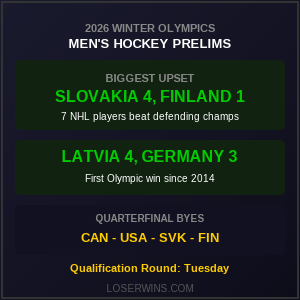
The tournament’s very first game set the tone. Slovakia, with just seven NHL players on their roster, beat a Finnish team comprised almost entirely of NHL talent 4-1 on February 11. Juraj Slafkovsky scored twice. Goaltender Samuel Hlavaj, an AHL netminder from the Minnesota Wild system, stopped 39 of 40 shots against a Finland squad that had been expected to contend for gold.
Finland outshot Slovakia 40-25, dominated possession, and still lost by three goals. That’s a pattern contrarian bettors recognize across every sport: the team that “should” win based on raw talent doesn’t always cover the number, let alone win the game.
The result cost Finland the Group B title. Despite bouncing back with an 11-0 demolition of Italy and a 4-1 win over Sweden, Slovakia’s head-to-head victory gave them the top spot. Finland finished as the best second-place team and still earned a quarterfinal bye, but the opening loss dropped them from the No. 1 seed in their group to the No. 4 overall seed.
Latvia Stuns Draisaitl and Germany
Saturday’s Group C action produced the tournament’s most dramatic underdog win. Latvia, coming off a 5-1 loss to the United States, rallied to beat Germany 4-3. Germany’s roster featured Leon Draisaitl, Tim Stutzle, and Moritz Seider. Latvia countered with Zemgus Girgensons and a collection of players from the AHL, European leagues, and the ECHL.
Germany led 2-1 after the first period, and the public had little reason to expect a collapse. Dans Locmelis tied it in the second with two power-play goals, then Eduards Tralmaks and Renars Krastenbergs scored in the third to put Latvia ahead 4-2. Stutzle’s late goal made it close, but the damage was done. Latvia’s goaltender Arturs Silovs stopped 26 of 29 shots.
It was Latvia’s first Olympic hockey victory since 2014 in Sochi, and only their fourth win in 20 Olympic games involving NHL players. The result reshuffled Group C standings and pushed Germany into the qualification round.
How the Groups Finished
Canada, the United States, and Slovakia each won their groups with perfect 3-0 records in regulation. Finland earned the fourth quarterfinal bye as the highest-ranked second-place team. The final seeds: Canada (No. 1), USA (No. 2), Slovakia (No. 3), Finland (No. 4).
The remaining eight teams enter Tuesday’s qualification playoffs in single-elimination games. The matchups are set by seeding: No. 5 Switzerland vs. No. 12 Italy, No. 6 Germany vs. No. 11 France, No. 8 Czechia vs. No. 9 Denmark, and No. 7 Sweden vs. No. 10 Latvia. Winners advance to Wednesday’s quarterfinals against the top four seeds.
Where the Contrarian Value Lives
Tuesday’s qualification round features several games where public perception may not match competitive reality. Italy, seeded last at No. 12, plays at home against Switzerland and will have passionate crowd support at the Milano arenas. Host nations have a long history of outperforming expectations in Olympic competition, and Italy has already shown flashes of competitiveness despite being outmatched on paper.
Latvia vs. Sweden is another matchup worth watching through a contrarian lens. Sweden lost to Finland 4-1 in their opener and needed a second-period comeback to beat Italy 5-2. They bounced back against Slovakia with a 5-3 win, but the Latvians already proved against Germany that they can compete with NHL-heavy rosters when their goaltending holds up. The Sweden-Latvia winner draws the United States in the quarterfinals, which may actually reduce the pressure on the underdog. Playing with house money in elimination games is where contrarian results tend to emerge.
Denmark earned their first win of the tournament on Sunday, beating Latvia 4-2 behind Nick Olesen’s two goals and Frederik Andersen’s 33 saves. They face Czechia on Tuesday. Denmark entered the Olympics as one of the lowest-ranked teams in the field, but Andersen gives them an NHL-caliber goaltender capable of stealing a game.
What Bettors Should Remember
The preliminary round reinforced a principle that applies across every sport: when the talent gap appears enormous, the public overvalues the favorite. Slovakia had seven NHL players against Finland’s near-complete NHL roster. Latvia’s best skaters play in the AHL and European leagues while Germany rolls out Draisaitl and Stutzle. In both cases, the underdog won outright.
Olympic hockey adds variables that compress talent gaps. Shortened preparation time means star-studded rosters can’t build chemistry the way NHL teams do over an 82-game season. International ice surfaces, different officiating standards, and the emotional weight of representing a country all create conditions where upsets happen more frequently than the odds suggest.
The qualification round starts Tuesday morning. Four games, four elimination scenarios, and at least a few spots where the public will overestimate the favorites again. The preliminary round already proved that much.