
The Numbers Don’t Lie
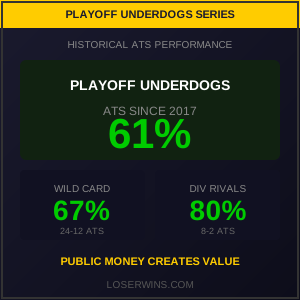
Since 2017, playoff underdogs have covered the spread in approximately 61% of all postseason games. That’s not a typo. While the public floods sportsbooks with action on favorites every January, the dogs keep cashing tickets.
The Wild Card round is where this trend shines brightest. Over the past eight postseasons, underdogs are 24-12 against the spread in the opening round of the playoffs. That’s a 67% cover rate. If you had bet $100 on every Wild Card underdog since 2017, you’d be sitting on nearly $1,000 in profit.
This pattern flies in the face of conventional wisdom. The playoffs are supposed to reward the best teams. Home-field advantage is supposed to matter more. The cream is supposed to rise. And yet, the numbers tell a different story.
Why Playoff Underdogs Cover
Several factors drive this edge. First, public money amplifies in the postseason. Casual bettors who ignored the NFL all season suddenly want action on their favorite team’s playoff run. Sportsbooks know this and shade their lines accordingly, creating value on the other side.
Second, the sample size shrinks. During the regular season, 272 games give oddsmakers plenty of data to calibrate their numbers. In the playoffs, you’re dealing with 13 games total. Small edges compound quickly. A team that was slightly undervalued all year can exploit that gap when every game matters.
Third, motivation equalizes. Wild Card teams fought through 18 games just to get here. They’re not content with participation trophies. Meanwhile, higher seeds sometimes show up expecting to win rather than fighting to win. That psychological gap doesn’t show up in the point spread.
Performance by Round
The underdog advantage isn’t uniform across the playoffs. Wild Card weekend produces the most consistent results, with that 67% cover rate standing out. This makes sense because it’s when the largest number of casual bettors enter the market and when the talent gap between seeds is smallest.
The Divisional Round sees more variance. Top seeds enter fresh off their bye week, and the matchups become more lopsided on paper. Still, underdogs have remained profitable here, covering at roughly 55% over the same timeframe.
Conference Championships are a coin flip. By this point, only quality teams remain. The lines tighten, the edges narrow, and you’re essentially betting on which elite team shows up sharper that day.
The Super Bowl is its own animal entirely. The two-week layoff, neutral site, and media circus create unique dynamics that don’t follow regular-season patterns. Historical underdog performance here is closer to 50-50.
Divisional Matchups Favor the Underdog
When playoff opponents are division rivals, the underdog edge magnifies. Since 2014, underdogs are 8-2 ATS when division opponents meet in the postseason. These teams know each other. They’ve played twice already. The underdog has tape, familiarity, and often a chip on their shoulder from regular-season losses.
This year’s Wild Card round features one such matchup. The contrarian approach that works in the regular season works even better when the teams share a division.
Home Underdogs: A Rare Breed
Home underdogs in the playoffs are uncommon. The seeding structure ensures that division winners host wild card teams, and those hosts are usually favored. But when home underdogs do appear, they’ve been money.
Since 2015, home underdogs are 6-2 ATS in playoff games. The sample is small, but the logic is sound. A team that wins its division, earns home-field advantage, and still gets points from the sportsbook? That’s a market inefficiency waiting to be exploited.
This year’s bracket includes at least one intriguing home underdog scenario worth watching as lines develop.
What This Means for 2026
The 2026 playoff field offers several spots where history suggests value. The Panthers, despite their 8-9 record, host the Rams as double-digit underdogs. The Bears and Packers play a near-pick’em as division rivals meeting for the third time in a month. The Bills travel to Jacksonville as road favorites against a team that’s already beaten them once this year.
None of this guarantees outcomes. Variance exists. Favorites do win, and sometimes they cover. But the underdog betting philosophy doesn’t require picking every winner. It requires identifying where the market has overcorrected, where public perception has inflated lines beyond fair value.
The playoffs are where public money peaks. And historically, that’s exactly when betting against the crowd pays off most consistently.
The Sample Size Question
Critics will point to sample sizes. Eight years of playoff data means roughly 100 games total. Is that enough to draw meaningful conclusions? The answer depends on how you think about betting markets.
Regular season betting trends require massive samples to prove significance because the market is efficient. Books have 272 games per year to calibrate their numbers. Any edge that exists gets arbitraged away quickly. But playoff markets operate differently. The unique conditions, the public money surge, the condensed schedule, these factors repeat every January regardless of which teams qualify.
The 61% cover rate for playoff underdogs isn’t a fluke of which teams happened to make the postseason. It’s a function of market dynamics that recur annually. Casual bettors flood the market every January. Sportsbooks shade lines to manage that action. The value on underdogs emerges from that structural reality, not from random variance.
Connecting to Regular Season Patterns
This playoff edge mirrors patterns from the regular season underdog data. During the regular season, underdogs have been profitable five consecutive years heading into 2025. The NFL betting market consistently undervalues teams getting points. The playoff amplification simply makes this tendency more pronounced.
If you’ve followed contrarian betting strategies during the season, the playoffs offer the same logic in concentrated form. The same public biases that create value on road dogs and divisional underdogs during the regular season create even larger value when every game has national attention.
The Bottom Line
Eight years of data show a clear pattern. Playoff underdogs cover more often than they should. Wild Card underdogs cover most often of all. And when the public piles onto favorites, the value shifts to the other side.
This doesn’t mean blindly betting every underdog. It means recognizing that the playoffs create a unique market environment. Casual money floods in. Lines inflate. And patient bettors who understand these dynamics can find edges that don’t exist during the regular season.
The 2026 playoffs begin Saturday. The patterns are established. The only question is whether you’re positioned to take advantage of them.