
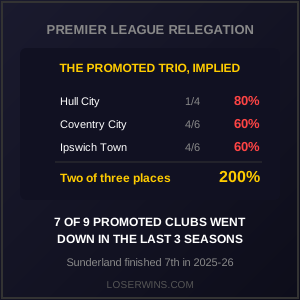
The 2026-27 Premier League relegation odds have been posted for weeks, and they’re worth an arithmetic check before anyone kicks a ball on August 21. Hull City sit at 1/4. Coventry City and Ipswich Town are priced anywhere from 8/13 to 5/6 depending on which book you read, with several settling on 4/6. Convert those to percentages and the three promoted clubs account for two of the three relegation places by themselves, with seventeen other teams still waiting to be counted.
That’s a strong claim for a board to make in August. The board made a version of it last August too, and two of those three clubs stayed up.
What the Board Assigns to Three Clubs
Fractional prices convert cleanly enough. 1/4 means 80 percent, 4/6 means 60, 5/6 means 54.5. Hull at 80 plus Coventry and Ipswich at 60 apiece comes to exactly 200, against the 300 percent available across twenty clubs for three places. Take the longer end of the range for the other two and the trio still reaches 189.
Then the space runs out fast. Sunderland, the shortest-priced club that hasn’t just come up, sits around 3/1, which is 25 percent. Crystal Palace, Leeds and Fulham have all been quoted at 11/2, or 15.4 each. Seven clubs, 271 percent. Thirteen teams are left to share whatever remains of the 300, and no book prices thirteen Premier League clubs that cheaply, so the real total runs past 300 and the overflow is the margin. Nothing unusual in that. What’s unusual is how much of it lands on three clubs who were playing Championship football in May.
Sunderland Finished Seventh
Twelve months ago the newcomers were Leeds, Burnley and Sunderland, and the consensus on them was brutal. Opta’s pre-season model, published by the BBC, simulated the season ten thousand times and put Leeds 19th and Sunderland 20th. The bookmakers agreed, and nobody bothered arguing.
Sunderland finished seventh and qualified for the Europa League. Leeds stayed up. Burnley went down, joined by Wolves and by a West Ham side whose 39 points were the most any relegated club had taken since 2011. Arsenal won the thing on 85 points, their first title in 22 years, and the story of the season at the other end was that two of the three promoted clubs survived comfortably while two established sides didn’t.
Premier League Relegation Odds Against the Recent Record
Now the part that complicates the easy reading. In 2023-24, Luton, Burnley and Sheffield United all went straight back down, which had happened once before in Premier League history and not since 1997-98. In 2024-25 it happened again, to Leicester, Ipswich and Southampton. Then last season delivered one relegation out of three.
Add it up: 3 plus 3 plus 1 is seven of nine promoted clubs relegated across three seasons, or 77.8 percent. The current trio averages 66.7 percent at the shortest prices and 63 at the longest. So the board sits below the three-year record instead of above it, which is the opposite of the usual complaint about newcomers heading the market.
A sample of nine clubs across three seasons settles nothing, and I’d say that about any figure built on a sample that small. It does show the number isn’t a lazy one. Whoever set it looked at the same three seasons and shaded slightly kinder than the raw count.
Hull Came Up Sixth
The trio also shouldn’t be treated as one object, which the aggregate arithmetic above quietly does. Coventry won the Championship under Frank Lampard and they’re back in the top flight after 25 years away, opening at the Emirates against the champions. Ipswich finished second and they were in the Premier League as recently as 2024-25, so most of that squad has seen what’s coming.
Hull got there through the playoff, beating Middlesbrough 1-0 at Wembley from sixth place, and their price reflects it. Eighty percent is above the three-year rate for promoted clubs generally, which means the market has singled them out rather than lumped them in. Reporting on the squad has focused on how few of their players have any top-flight minutes at all. That’s a specific argument about a specific club, and it’s a better one than the pattern-matching that produces the other two numbers.
The Case for Leaving This Alone
Everything above describes a market that might be slightly conservative. None of it says anyone should bet against it, and the reasons matter more than the observation.
The mechanism behind promoted-club failure hasn’t gone anywhere. Clubs coming up spend a season’s revenue trying to close a gap that the seventeen incumbents have been widening for years, and parachute payments cushion the fall for whoever goes down while doing nothing at all for whoever comes up. Sunderland spent real money in the summer of 2025, and then they finished seventh. Whether Hull can do the same before the window shuts on August 31 is a question about a transfer budget, not about a historical pattern.
The other thing to keep in view is what the reverse price actually pays. Hull to stay up sits near 20 percent implied before margin, which is +400 in American terms. That looks generous until you remember it’s the same 20 percent, and a market being slightly conservative on a group doesn’t make any individual number on it wrong. Our win rate data by sport keeps landing on the same point: a long price is information about how the market sees a team, and turning it into an edge takes more than noticing that the price is long. The contrarian case has never been that favorites lose more often than the number says.
The Community Shield goes on Sunday at the Principality Stadium in Cardiff, Manchester City against Arsenal, moved from Wembley because of a concert. Sunderland’s seventh-place finish will get retold for years, the way soccer’s famous shocks do, and for the same reason. The alternative is what usually happens. Coventry find out on August 21 at the Emirates, against the champions, first match of the season.