
The Day All Four Top Seeds Lost
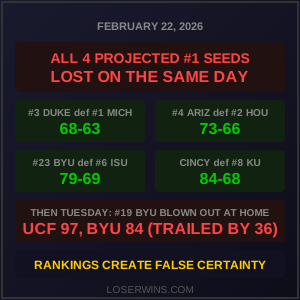
Saturday, February 21 was supposed to clarify the college basketball landscape three weeks before Selection Sunday. Instead, it detonated it. All four projected No. 1 seeds from the NCAA selection committee’s preliminary bracket reveal lost on the same day. Michigan, Houston, Iowa State and Kansas (the team closest to cracking that top line) all went down within hours of each other.
By Tuesday night, the aftershock was still rolling. No. 19 BYU – fresh off upsetting Iowa State just 48 hours earlier – got demolished 97-84 at home by unranked UCF. The Cougars never led for a single second. They trailed by 36 in the second half.
For contrarian bettors, this kind of week is a reminder of something the betting market keeps forgetting: rankings create false certainty. And false certainty creates value.
Saturday’s Damage Report
Here’s what happened to the four teams the NCAA committee had slotted as No. 1 seeds just hours before tip-off:
No. 1 Michigan (-2.5) fell to No. 3 Duke 68-63 in Washington, D.C. Cameron Boozer posted 18 points and 10 rebounds while Duke outrebounded Michigan 41-28. The Wolverines were public favorites with the nation’s top-ranked offense averaging over 90 points per game. They scored 63.
No. 2 Houston lost at home to No. 4 Arizona, 73-66. The Cougars went scoreless from the field for nearly 10 minutes in the second half, missing 10 straight shots while Arizona ripped off a 12-0 run. Houston hadn’t lost a two-game losing streak in over two years before Saturday.
No. 6 Iowa State (-3.5) fell at No. 23 BYU, 79-69. AJ Dybantsa torched the Cyclones with 29 points, 10 rebounds and nine assists. BYU outscored Iowa State 40-22 in the paint and controlled the glass 39-28.
No. 8 Kansas got blown out at home by unranked Cincinnati, 84-68. At Allen Fieldhouse. By 16 points. Cincinnati shot 48% and dominated the rebounding battle 40-29. Kansas dropped six spots to No. 14 in Monday’s AP poll.
Then Tuesday Made It Worse
BYU’s win over Iowa State looked like a signature moment for Kevin Young’s program. Two days later, the Cougars laid down one of their worst performances in years. UCF shot 14-for-24 from three-point range (58%) and led by as many as 36 points. BYU trailed 24 at halftime. The garbage-time scoring in the second half made the 97-84 final look far more competitive than the game actually was.
“We were sleepwalking out there,” Young said afterward. “They punked us.”
For bettors, BYU’s collapse illustrates a pattern that shows up repeatedly in February college basketball: the public overreacts to single results. After beating Iowa State, BYU was a popular pick to ride momentum deeper into March. But momentum in college basketball is a coin flip dressed up as a narrative.
What the Market Keeps Getting Wrong
The AP poll reshuffled on Monday. Duke climbed to No. 1 for a record 148th time in program history, grabbing 56 of 61 first-place votes. Arizona jumped to No. 2. Michigan slid to No. 3 despite having just two losses all season.
But here’s what the reshuffling obscures: there is almost no meaningful gap between the top 10 teams in college basketball right now. Duke is 25-2. Arizona is 25-2. Michigan is 25-2. Any of them could lose to the other on a given night, and any of them could lose to a team ranked 15 spots lower if the matchups break wrong.
The latest AP poll features six Big 12 teams, five Big Ten teams, and five SEC teams in the top 25. That concentration means every conference game is a potential landmine, and the public’s tendency to back the higher-ranked team regardless of matchup creates consistent contrarian value.
The February Pattern and March Implications
This season has been a masterclass in ranked-team volatility. Over the past two weeks alone, our coverage has tracked five ranked upsets in a single Tuesday, Wednesday night chaos with UConn and Auburn falling, and now Saturday’s four-seed wipeout.
The data keeps pointing in the same direction. Rankings are trailing indicators of past performance. They tell you where a team has been, not where it’s going. And the closer we get to March, the more the talent gap compresses as every team plays with desperation. Conference tournament bids, NCAA seeding, and bubble survival all create environments where underdogs historically perform well.
Houston has now dropped to 23-4 after losing consecutive games to Iowa State and Arizona, its first back-to-back defeats in over two years. Vanderbilt went from 16-0 to 5-6 over its next 11 games and dropped to No. 25. Kansas, which was in the top eight two weeks ago, sits at No. 14 after the Cincinnati blowout. These aren’t flukes. They’re the market catching up to reality.
What Contrarian Bettors Should Watch
Three weeks remain before Selection Sunday. Conference tournaments start in early March. The window for public overreaction is wide open, and it works both ways. Teams that won big on Saturday (Duke, Arizona) will absorb public money that inflates their lines. Teams that lost (Kansas, Houston, BYU) will be faded by the public, potentially creating value if the market overcorrects.
The bottom line: when all four projected No. 1 seeds lose on the same day, the correct takeaway for bettors isn’t that the rankings are wrong. The takeaway is that the rankings were never as meaningful as the public believed them to be. And that gap between perception and reality is where contrarian value lives.