
Taylor Fritz lost a quarterfinal on Friday afternoon in Ohio, beaten 7-6(9), 4-6, 6-3 by Brandon Nakashima, the 27th seed. On the same day his price to win the US Open more than tripled. Both of those things happened, and the second one had nothing to do with him.
What happened instead was the Sinner US Open withdrawal. Jannik Sinner announced on Friday that a knee problem would keep him out of the final major of the year, having not hit a competitive ball since winning Wimbledon in July. The knee had already cost him Toronto and Cincinnati. On Friday it took New York.
What the Sinner US Open Withdrawal Was Worth
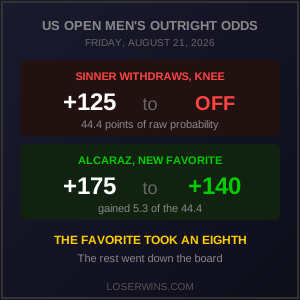
Yahoo Sports carried the before-and-after board. Sinner sat at +125 before the announcement with Carlos Alcaraz at +175. Afterwards Alcaraz was +140 and Alexander Zverev second at +300.
Convert those and something odd shows up. A +125 line implies 44.4 percent of raw probability, and all of it left the board. Alcaraz went from 36.4 to 41.7, a gain of about five points. The new favorite absorbed roughly an eighth of what the old favorite gave up. Everything else went somewhere down the list.
OddsShopper, comparing a Thursday board against a Friday one, found the biggest relative gain anywhere belonged to Fritz, whose number more than tripled. Nothing about Fritz improved on Friday. His route did. Ben Shelton is the complication. He sat at 7 percent with Sinner in the field and 7 percent with him out, which is a market saying it doesn’t think Sinner was ever in Shelton’s way.
Carry one caveat with all of that. OddsShopper’s two snapshots come from different venues, Kalshi on Thursday and Polymarket on Friday, so the comparison reads as direction rather than as a tick-by-tick move.
Eight Days of Results That Moved Nothing
While that was happening off court, Cincinnati spent a week dismantling itself.
Sinner and Alcaraz never entered, citing a knee and a wrist. Alexander Zverev, the top seed, lost to Tommy Paul. Felix Auger-Aliassime, the second seed, went out to Frances Tiafoe on the same day, so the tournament lost both of its top seeds inside a few hours. Novak Djokovic had already gone in the second round to Thiago Agustin Tirante, ranked 50th, a match we looked at on Tuesday. Then Fritz went out to Nakashima.
The four men in today’s semifinals are seeded 7, 17, 21 and 27. Flavio Cobolli and Arthur Fils meet at 1:30 Eastern in a match that guarantees a first-time Masters 1000 finalist, since neither has ever reached one. Tiafoe plays Nakashima in the evening.
Nakashima’s week deserves its own paragraph. A week ago he had never won a Masters 1000 round-of-16 match in five attempts. He then reached the Montreal final, and per Tennis Majors he’s the first player ranked outside the top 20 to make the last eight in Washington, Montreal and Cincinnati in the same season since Andy Murray in 2006.
Why One Thing Counted and the Other Didn’t
None of the Ohio results moved a US Open price in any way worth measuring. The Sinner US Open withdrawal did, immediately and by a lot.
The reason is unglamorous. Futures markets price a field, and a loss in Cincinnati removes nobody from the field in New York. Fritz will be in that draw whatever happened on Friday afternoon. Sinner won’t. One of those facts changes the set of people who can win the tournament, and the other changes only what a bettor feels about somebody’s form.
That asymmetry is worth sitting with, because form is what most people spend the week watching. Eight days of a Masters 1000 tearing the top off its own draw produced no measurable movement in the market that matters, and a statement on social media from a man who wasn’t in the building produced all of it.
What Could Make This Reading Wrong
Shelton is the honest objection. If a withdrawal simply redistributed probability across the field, every remaining name would rise a little. Shelton didn’t move at all, which means the market wasn’t redistributing evenly. It was making a judgment about who Sinner’s half of a draw would have contained, and the draw for the US Open hasn’t been made yet. That judgment could easily be wrong, and the numbers moving on Friday partly reflect guesses about a bracket that doesn’t exist.
The venue problem cuts the same way. Comparing a Kalshi board on Thursday to a Polymarket board on Friday introduces a difference that has nothing to do with news. And a sportsbook’s +140 converts to 41.7 percent raw against roughly 36 on the prediction markets, which is a five-point gap that is mostly margin rather than disagreement.
Where It Lands Next
Somebody wins in Cincinnati tomorrow afternoon. Whoever it is finishes the week with a Masters 1000 title he was priced nowhere near on Monday. Rankings that set the US Open seeds publish next week, and at that point whatever the market has been reading into this tournament turns into something structural: a seed number and a place in a bracket.
Main draw begins August 30. Sinner won’t be in it, Alcaraz will, and the difference between those two sentences was worth more on Friday than every match played in Ohio since the 13th. Say what you like about the tennis in Cincinnati this week. A futures price is built from availability first, and from form somewhere considerably further down.