
Chalk Dominated the First Weekend. The Public Wants More.
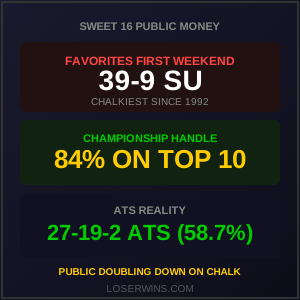
The 2026 NCAA Tournament’s opening weekend produced one of the most favorite-friendly results in modern bracket history. Higher-seeded teams went 39-9 straight up through the first two rounds, and on Friday alone, favorites swept all 16 games for the first time since 1992. Just 13 outright underdog wins across the entire first weekend tied for the fewest since the field expanded to 64 teams in 1985.
Now the Sweet 16 tips off Thursday, and the betting market is responding predictably. Public money is flooding toward favorites in nearly every game, and championship futures handle has consolidated around a handful of top seeds. According to early data from theScore Bet, 84% of championship handle since the tournament started has landed on just 10 teams. That leaves seven surviving programs splitting roughly 16% of the money between them.
For contrarian bettors, the question becomes: has the public over-learned from four days of chalk dominance? The fade-the-public approach tends to find its best opportunities when consensus confidence peaks. And right now, consensus confidence is about as high as it gets.
Where Public Money Is Heaviest
Early Sweet 16 betting splits reveal some striking one-sided action. According to VegasInsider, roughly 78% of spread bets and 81% of handle have landed on Houston (-2.5) against Illinois. The Cougars play at Toyota Center, essentially a home game two miles from campus, and the public sees an easy path to the Elite Eight.
The most lopsided spread action belongs to the Arkansas-Arizona matchup, where early reports indicate approximately 88% of ATS handle has landed on the Razorbacks as 8.5-point underdogs. That’s unusual. The public rarely backs a Sweet 16 underdog that aggressively, which suggests the number itself may be doing the talking. When the line looks too generous, bettors pile on, and sportsbooks respond accordingly. The line has already ticked down toward 7.5 at some shops.
The public is also siding with the over in all eight games at this early stage. In the Texas-Purdue matchup, 95% of over/under bets and handle have landed on the over 148.5. That level of unanimity typically signals an adjustment is coming.
Michigan: 33-3 Record, 16-20 Against the Spread
The biggest spread on the Sweet 16 board belongs to No. 1 Michigan, laying 10.5 points against No. 4 Alabama. Michigan is the tournament favorite, a dominant 33-3 team that scored 101 and 95 points in its first two tournament wins. The public loves them.
The ATS record tells a different story. Michigan is 16-20 against the spread this season, per Covers.com. The Wolverines have failed to cover in eight of their last 10 games entering the Sweet 16. They win by comfortable margins, but rarely by enough to satisfy double-digit spreads. A 10.5-point line against an Alabama team that can match Michigan’s tempo and scoring creates the exact kind of gap where public perception diverges from actual spread value.
Nobody is saying Michigan loses this game. But covering 10.5 in the Sweet 16, where pressure tightens possessions and coaching adjustments have days to develop, is a different conversation entirely.
Injuries the Market Is Underpricing
Two significant injury situations are lurking beneath the surface of the Sweet 16 lines, and neither has moved the number much.
Duke is a 6.5-point favorite over St. John’s, but the Blue Devils are missing guard Caleb Foster (fractured foot) and got just 13 minutes from big man Patrick Ngongba II in their second-round win over TCU. Duke has compensated with Cameron Boozer’s brilliance and Isaiah Evans stepping up, but a shorter rotation in the Sweet 16 against a St. John’s team that has won 20 of its last 21 games changes the math. The Red Storm aren’t some plucky mid-major. They’re a 30-6 team that won the Big East Tournament and beat Kansas on a buzzer-beater to reach this point.
In the South region, Iowa State is dealing with the uncertain status of Joshua Jefferson, who injured his ankle in the first round. Jefferson ranks second nationally in KenPom’s Player of the Year metric. The Cyclones blew out Kentucky without him, which may have actually hurt the contrarian case by convincing the public that Iowa State doesn’t need him. Tennessee, their Sweet 16 opponent, plays elite defense and won’t be as forgiving.
Three Near Pick’em Games Deserve Attention
While the public focuses on big favorites, the tightest Sweet 16 matchups may offer the most interesting contrarian dynamics.
Michigan State vs. UConn carries the smallest spread at 1.5 points (UConn favored). These are two top-10 KenPom teams with similar stylistic profiles. Jeremy Fears Jr. posted 16 assists against Louisville in the second round, the most by a Big Ten player in an NCAA Tournament game in 50 years. UConn has balance, five double-digit scorers, and Dan Hurley’s tournament pedigree. This game could go either direction, and the spread reflects genuine uncertainty.
Illinois vs. Houston (-2.5) pits the second-ranked offense in KenPom against the fourth-ranked defense. Houston’s home-court advantage at Toyota Center is real, but Illinois is the biggest team in the country and dominated its first two opponents. The 2.5-point spread in a game between teams this evenly matched leaves very little margin.
Nebraska vs. Iowa (-1.5 Nebraska favored) features two Big Ten rivals who split their regular-season series. Nebraska has never won a Sweet 16 game in program history. Iowa just pulled off the tournament’s biggest upset, knocking off defending champion Florida on a last-second three-pointer. These teams know each other, and familiarity tends to produce close games.
Historical Context for Sweet 16 Underdogs
The Sweet 16 typically produces tighter games than the opening rounds. The talent gap narrows as lower-seeded teams have been eliminated, and coaching staffs get several days to prepare game plans. In recent years, underdog covers in the Sweet 16 have occurred at a meaningful rate, particularly when lines stretch past a touchdown.
This year’s field features only two seeds outside the top five: No. 9 Iowa and No. 11 Texas. The rest are all 1-through-5 seeds, making this one of the most top-heavy Sweet 16 fields in tournament history. That concentration of talent should, in theory, make the games closer. Yet the betting market has set four spreads at 6.5 points or more, suggesting the public is still pricing these games as if the opening-weekend blowouts will continue.
The contrast between the market’s expectation and the historical tendency of the Sweet 16 to produce competitive games is exactly the kind of structural inefficiency that contrarian philosophy targets.
What the First Weekend Actually Told Us
Yes, chalk dominated. But even within that dominance, the ATS picture was more nuanced. Favorites went 27-19-2 against the spread through the first two rounds. That’s a 58.7% cover rate, solid but hardly the kind of number that justifies blanket confidence in every favorite going forward. Underdogs went 10-6 ATS on Day 1 of the Round of 64, and Iowa’s upset of Florida as a 10.5-point underdog proved that the bracket’s top seeds aren’t invincible.
The public tends to project the most recent results forward in a straight line. Four days of chalk means chalk will continue, the thinking goes. But tournament basketball doesn’t work that way. The games get harder, the stakes get higher, and the margins get thinner. If you’re looking for contrarian spots in the Sweet 16, the data suggests you won’t have to look far.