
States Squeeze Sportsbooks
Sports betting operators entered 2026 facing a new reality: rising tax burdens that threaten profitability and may ultimately affect the odds offered to bettors. Illinois led the charge with unprecedented tax increases, and other states are following. For contrarian bettors, understanding this squeeze helps explain why lines may vary more dramatically by state and why shopping for the best number matters more than ever.
The Illinois Experiment
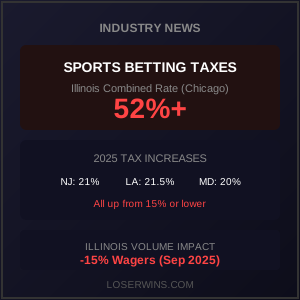
Illinois has become the test case for aggressive sports betting taxation. In 2024, the state replaced its flat 15% tax rate with a tiered system ranging from 20% to 40% based on operator revenue. Then in July 2025, Illinois introduced something no state had tried before: a per-bet tax of $0.25 on the first 20 million wagers and $0.50 on every bet thereafter.
The per-bet tax hit operators hard. FanDuel and DraftKings responded by passing the fee directly to customers, adding visible charges to betslips. Other operators instituted minimum bet amounts. The result: wagering volume dropped 15% in September 2025 compared to the prior year, though average bet size increased 28% as bettors consolidated smaller wagers.
Then Chicago added more. Mayor Brandon Johnson’s 2026 budget includes a 10.25% city tax on online sports betting revenue, on top of state and county levies. For large operators like FanDuel and DraftKings, the combined rate on Chicago-generated revenue can exceed 52% for significant portions of the year.
The National Trend
Illinois isn’t alone. Multiple states increased sports betting taxes in 2025:
New Jersey: Raised online sports betting tax from 14.25% to 21% after Governor Phil Murphy initially proposed 25%.
Louisiana: Increased from 15% to 21.5%, though legislators blocked an initial proposal of 50%.
Maryland: Moved from 15% to 20%.
More increases are expected in 2026. Kansas is renegotiating terms with its licensed sportsbooks. Failed tax hike efforts in Indiana, Pennsylvania, Massachusetts, North Carolina, Ohio, and Wyoming may get a second look. Ohio Governor Mike DeWine’s proposal to double the state’s 20% rate to 40% stalled in 2025 but could return.
Why This Matters for Bettors
When operators face higher costs, those costs flow somewhere. The options are reduced promotional spending, tighter lines, or direct fees passed to customers. Illinois bettors are already seeing the third option explicitly on their betslips.
For contrarian bettors, this creates opportunity. Line shopping across operators and states becomes more valuable when operators have different cost structures. An operator with lower tax burden may offer a slightly better number. Over thousands of bets, those half-points and reduced juice add up.
The closing line value you capture depends partly on finding the best available number. Tax differences between jurisdictions are now a factor in which books offer the sharpest lines.
The Prediction Market Angle
Rising state taxes make the prediction market regulatory battle more interesting. Prediction markets argue they’re federally regulated and not subject to state gambling taxes. If that legal position holds, they gain a cost advantage over traditional sportsbooks operating in high-tax states.
Louisiana Gaming Control Board Chairman Christopher Hebert warned at a recent legislative conference that excessive taxation drives activity to illegal markets. The same logic applies to prediction markets: if state-regulated sportsbooks become too expensive, bettors may migrate to alternatives, whether offshore books or prediction market platforms.
Prediction market sports volume now equals roughly 5% of total legal US sports betting handle, with much of that activity coming from states where traditional sportsbooks can’t operate. Tax-driven cost increases could accelerate that trend.
The Contrarian View
Sportsbooks have consolidated significantly since legalization began in 2018. FanDuel and DraftKings control roughly 78% of the market. That concentration gives them pricing power but also makes them targets for tax-hungry legislatures.
The public keeps betting regardless of tax policy changes. Casual bettors don’t comparison shop or consider the structural costs embedded in their wagers. They bet with whichever app is on their phone.
Contrarian bettors should approach the tax squeeze differently. Line shop aggressively. Consider accounts at multiple books in multiple jurisdictions if accessible. Track whether books in high-tax states start offering worse lines than their lower-tax competitors. And recognize that the industry’s profitability challenges may eventually affect product quality, promotional generosity, and market availability.
The free-spending promotional era of sports betting is ending. States want their cut. The contrarian edge now includes understanding which operators are best positioned to absorb those costs while still offering competitive lines.