
Home Favorite to Home Underdog
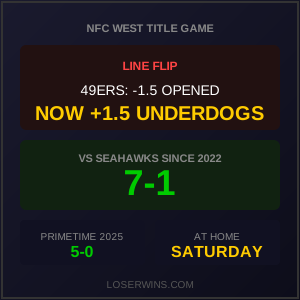
Something unusual happened this week in the betting market. The San Francisco 49ers opened as 1.5-point favorites at home against the Seattle Seahawks. By Tuesday, that line had flipped. The 49ers are now 1.5-point underdogs in their own building.
The game is Saturday night. Winner takes the NFC West title and the conference’s only first-round bye. Both teams have clinched playoff spots. Both enter on six-game winning streaks. The stakes could not be higher.
Yet the market has decided the team playing at home, with a dominant recent history in the head-to-head matchup, is the underdog.
What the Market Sees
The line movement tells a clear story. Bettors are concerned about San Francisco’s injury situation heading into a short week.
Left tackle Trent Williams suffered a hamstring injury on the opening play of the Week 17 win over Chicago. He chased down a defender after Brock Purdy threw a pick-six and pulled up hurt. Williams did not practice Tuesday and appears unlikely to play Saturday.
Tight end George Kittle missed Week 17 with an ankle injury. He returned to limited practice Tuesday and is pushing to play, but his status remains uncertain. Linebacker Fred Warner has been out since October with an ankle injury requiring surgery. Reports describe his return this season as a “long shot.”
Running back Christian McCaffrey showed up on the injury report with a back issue. He called it “not serious,” but on a short week, any limitation matters.
What the Market May Be Missing
The 49ers have been dealing with injuries all season. They keep winning anyway.
Without Williams against Chicago, backup Austen Pleasants played 71 snaps. San Francisco scored 42 points. The offense looked fine. Maybe not Trent Williams fine, but functional enough to win a shootout against a playoff-bound Bears team.
More relevant: the 49ers have owned this matchup recently. San Francisco has won seven of the last eight meetings with Seattle, including a 17-13 victory in Week 1 of this season. That game was in Seattle. This one is at Levi’s Stadium.
The 49ers are 5-0 in primetime games this year. The Seahawks, despite their strong record, are 1-7 against San Francisco since September 2022.
Winner-Take-All Motivation
Context matters in spots like this. If San Francisco wins, they clinch the NFC’s top seed. They get a bye week, which would give Williams and Kittle extra time to recover. They avoid the chaos of Wild Card weekend entirely.
The 49ers already hold the head-to-head tiebreaker over Seattle from their Week 1 win. A victory Saturday locks everything up. That kind of motivation tends to produce focused performances.
Seattle has plenty at stake too. A win would be their 14th of the season, the most in franchise history. The Seahawks are a legitimately good team with one of the league’s best defenses. Sam Darnold has thrown 25 touchdowns. This is not a team to dismiss.
But San Francisco opened as the favorite for a reason. The injuries are real, but the market may be overcorrecting.
Historical Pattern Worth Noting
Home teams with significant line movement against them often represent value when the underlying fundamentals haven’t changed. The 49ers are the same team that won 12 games. They beat Seattle already this year. They’ve won seven of eight against this opponent.
Markets react quickly to injury news. Sometimes too quickly. A flip from -1.5 to +1.5 represents a three-point swing based largely on one player’s hamstring.
The psychology of betting underdogs applies even when the underdog is at home. The public sees a banged-up team and moves away. But injuries are factored into lines. The question is whether the adjustment is proportional.
The Contrarian Case
San Francisco as a home underdog in a winner-take-all game against a team they’ve beaten seven of eight times represents exactly the kind of situation contrarian bettors look for.
Does that mean the 49ers will win? Nobody knows. Seattle’s defense is elite. Darnold has been efficient. The Seahawks are on their own six-game streak and playing their best football of the season.
But when a team flips from favorite to underdog at home based primarily on injury concerns that existed before they scored 42 points in their most recent game, the market may be telling you more about public perception than about actual probability.
The value, if it exists, is in recognizing when the crowd has moved too far in one direction.