
Bears Packers Line Movement: When the Line Flips, Pay Attention
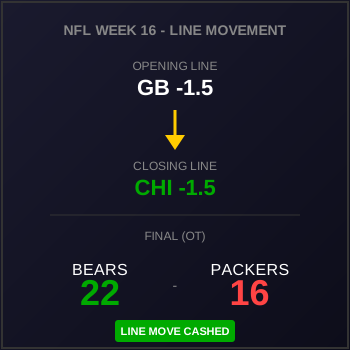
The Bears Packers line movement in Week 16 told a story before a single snap was played. Chicago’s 22-16 overtime victory on Saturday night delivered more than just a crucial NFC North win. It delivered a lesson in reading line movement that contrarian bettors should file away for future reference.
When the week began, Green Bay was a 1.5-point favorite at Soldier Field. By kickoff, Chicago had flipped to -1.5. That 3-point swing reflected something the betting market understood before most casual observers caught on: the Packers without Micah Parsons are a fundamentally different team.
Why the Bears Packers Line Movement Happened
Parsons tore his ACL against the Broncos in Week 15. The former Cowboys star had accumulated 12.5 sacks this season after being traded to Green Bay before the opener. Beyond the raw numbers, Parsons commanded attention from opposing offensive coordinators in a way that benefited every other defender on the field.
Sharp money recognized this immediately. The line didn’t just shift slightly. It reversed direction entirely. When you see a home team go from underdog to favorite without any injury news of their own, you’re watching informed money speak.
The Bears entered the game with momentum of their own. Chicago had won six of seven, including a 31-3 demolition of Cleveland. Their defense led the NFL in takeaways. More importantly, Caleb Williams had started looking like the franchise quarterback the Bears drafted him to be.
How the Game Validated the Move
For three quarters, the Packers seemed ready to prove the line movement wrong. Jordan Love led Green Bay to a 16-6 lead heading into the fourth quarter. The Bears hadn’t scored a touchdown all night. Cairo Santos had connected on two field goals, but Chicago’s offense looked stuck in the cold.
Then everything changed.
With under two minutes remaining, the Bears faced a seven-point deficit. Santos hit a 43-yard field goal to cut it to 16-9. On the ensuing kickoff, Chicago recovered an onside kick. Williams drove the Bears 53 yards in 1:35, hitting rookie Jahdae Walker on a contested fourth-down throw in the back of the end zone. Suddenly, after a scoreless night, it was 16-16.
In overtime, the Packers went three-and-out when backup Malik Willis fumbled a snap on fourth down. Williams needed just one play to end it: a 46-yard strike to DJ Moore.
What This Teaches Us
The game demonstrated several principles that line movement analysis relies on.
First, injury information gets priced in quickly by sharp bettors but slowly by the public. Casual bettors still saw the Packers as the team that had won 11 straight against Chicago. They saw Aaron Rodgers as the established quarterback against a second-year passer in freezing temperatures. They bet accordingly. Meanwhile, professional money recognized that losing Parsons changed the defensive equation entirely.
Second, line movement that reverses direction is particularly meaningful. A line moving from -3 to -2.5 reflects normal action. A line flipping from one team to the other suggests the initial number was fundamentally wrong once new information emerged.
Third, variance still matters. The Bears needed an onside kick recovery and a fourth-down touchdown to avoid losing outright. That doesn’t mean the line movement was wrong. It means football games involve uncertainty, and even good bets don’t always cover comfortably.
The Broader Context
This game fits a pattern we’ve seen throughout the 2025 season. When key defenders go down with injuries, the market adjusts more aggressively than casual bettors expect. The public tends to overvalue name recognition and recent results while undervaluing the specific impact of individual players on team performance.
The Bears’ win also reflects something important about betting psychology. Many bettors would have looked at the Packers’ 11-2 record against Chicago under Matt LaFleur and assumed that streak would continue. Historical trends have value, but they can’t account for roster changes that alter the fundamental matchup.
Chicago now leads the NFC North at 11-4. Green Bay falls to 9-5-1 and faces difficult questions about whether they can make a playoff run without their best defensive player. The Bears, meanwhile, have positioned themselves for their best season in years.
The Takeaway
When a line flips direction during the week, don’t ignore it. The Saturday night thriller at Soldier Field showed why. The Bears weren’t just the right side because they won. They were the right side because the market correctly identified that the Packers without Parsons were overvalued based on reputation rather than current reality.
That’s what line movement tells you when you know how to read it. Not who will win, but where the value sits. On Saturday, the value sat with Chicago. The dramatic finish was a bonus.