
The Last Time This Happened
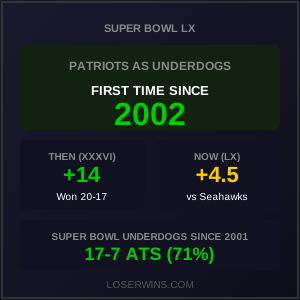
The New England Patriots enter Super Bowl LX as 4.5-point underdogs against the Seattle Seahawks. For a franchise that dominated the betting landscape for two decades, that status carries unusual weight. The last time the Patriots were underdogs in the Super Bowl, they were 14-point dogs against the St. Louis Rams.
That game launched a dynasty. The Patriots won 20-17.
From that February 2002 upset through their last Super Bowl appearance in 2019, New England was favored in eight consecutive championship games. Now, for the first time in 24 years, the Patriots enter the big game getting points instead of giving them. The contrarian implications are hard to ignore.
Eight Straight as Favorites
The scope of New England’s Super Bowl betting dominance is remarkable. From Super Bowl XXXVIII through Super Bowl LIII, the Patriots were chalk every time. They won six championships along the way. The betting public grew conditioned to laying points with New England in February.
That conditioning creates opportunity. Public bettors who spent two decades backing the Patriots as favorites now face a cognitive disconnect. The same franchise, but a different role. Many will default to their old patterns and back Seattle simply because it feels strange to take points with the Patriots.
Sharp money tends to exploit exactly these kinds of perception gaps.
The 2002 Parallel
The similarities between Super Bowl XXXVI and Super Bowl LX extend beyond the underdog status. In 2002, Tom Brady was a second-year quarterback who had taken over for an injured starter. The Patriots defense carried the team through difficult situations. The opponent featured one of the league’s most explosive offenses.
Today, Drake Maye is a second-year quarterback leading a team built on defensive excellence. The Seahawks rank first in the NFL in points allowed. According to ESPN, New England allowed just 26 total points across three playoff games. The template feels familiar.
The spread difference is notable. At 14 points, the 2002 Patriots faced the second-largest Super Bowl spread in history. At 4.5 points, the current Patriots face a much smaller margin. If the historical pattern holds any predictive value, the reduced spread represents less value to overcome.
The Underdog Streak
Super Bowl underdogs have covered five consecutive games, winning four of them outright. The last three Super Bowl winners were all getting points. Since 2001, underdogs are 17-7 against the spread in the championship game, a 71% cover rate that far exceeds any other playoff round.
The two-week gap before the Super Bowl consistently amplifies public bias toward favorites. Casual bettors flood the market, and the spread often moves beyond what sharp money considers justified. The line has already shifted from the opening -3.5 to -4.5, suggesting early public money is indeed flowing toward Seattle.
Preseason Long Shots
Both the Patriots and Seahawks entered the 2025 season at +6000 to win the Super Bowl. Regardless of who wins on February 8, the champion will be the longest preseason shot to claim the Lombardi Trophy since 2001.
That 2001 champion? The Patriots, who beat the Rams in Super Bowl XXXVI.
The symmetry extends to the franchises themselves. New England went from 4-13 in 2024 to 14-3 this season, the kind of year-over-year turnaround that typically takes multiple seasons. Seattle was picked to finish third or fourth in its own division and ended up with the NFC’s top seed. The betting market underestimated both teams all year.
The Vrabel Factor
Mike Vrabel won three Super Bowls as a Patriots linebacker, including that 2002 upset. He can become the first person in NFL history to win a championship as both a player and head coach with the same franchise. The historical echoes are almost too neat.
For bettors, the Vrabel storyline matters less than the structural dynamics. First-year head coaches reaching the Super Bowl historically face steep odds, yet Vrabel is the eighth to do so. The sample is small, but past results show first-year coaches can win the big game.
What the Data Suggests
The Patriots as Super Bowl underdogs for the first time since 2002 creates a specific scenario with historical precedent. That 2002 team covered a 14-point spread. This team faces a 4.5-point margin with similar structural advantages: elite defense, young quarterback, and a market that underestimated them all season.
Underdogs have dominated recent Super Bowls. The Patriots fit the profile of teams that succeed in that role: strong defensively, capable of controlling game pace, and carrying less public expectation than the opponent. None of this guarantees a cover, but the historical data tilts in a clear direction.
The last dynasty began with an underdog win. Whether this one does too remains to be seen.