
Nevada’s Super Bowl Handle Just Hit a 10-Year Low. Where Did the Money Go?
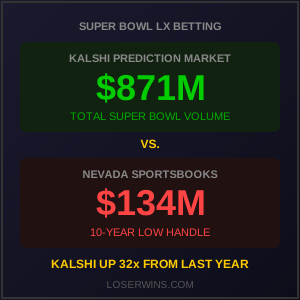
The Nevada Gaming Control Board released its Super Bowl LX wagering figures on Monday, and the headline number stunned the industry. Nevada’s 186 sportsbooks handled $133.8 million on the Seahawks’ 29-13 win over the Patriots. That’s the lowest Super Bowl handle in the state since 2016, when $132.5 million was wagered on Denver’s win over Carolina.
The year-over-year decline? Down 11.7% from the $151.6 million wagered on last year’s Eagles-Chiefs matchup. Down nearly 30% from the $190 million record set in 2024, when the Super Bowl was played at Allegiant Stadium in Las Vegas.
Sportsbooks still had a profitable day. They won $9.9 million for a 7.4% hold, the second-best win rate in the last five Super Bowls. But the shrinking handle tells a bigger story, and it has very little to do with football.
Kalshi Handled Nearly 4x Nevada’s Entire Total on One Outcome
While Nevada’s handle declined, prediction market platform Kalshi posted its biggest day in history. Gaming journalist Dustin Gouker, writing on his Closing Line Substack, reported that Kalshi took in roughly $871 million in total Super Bowl volume across all markets. That includes everything from game winner contracts to bets on halftime show performances and television commercial outcomes.
On the game winner contract alone, Kalshi processed approximately $497.7 million in volume. One outcome. One platform. Nearly four times what 186 Nevada sportsbooks combined across every spread, moneyline, prop, parlay, and live bet they offered.
For context: Kalshi handled just $27 million in total Super Bowl volume last year. The jump to $871 million represents a roughly 32-fold increase in 12 months.
Prediction Markets Are Playing a Different Game
The comparison between sportsbook handle and prediction market volume requires some nuance. Sportsbooks spread action across hundreds of markets. A single $100 bet on the spread doesn’t show up the same way as a prediction market contract that can be bought and sold multiple times before settlement. Trading volume counts every transaction, meaning the same dollar can be counted more than once as contracts change hands.
That caveat matters. But it doesn’t erase the trend. Research firm H2 Gambling Capital estimated total prediction market trading volume for the Super Bowl at around $630 million, with Kalshi alone exceeding that forecast. H2 separately estimated traditional sportsbooks would handle approximately $1.78 billion nationally.
The structural differences between these platforms explain some of the volume shift. Prediction markets reduce bets to binary yes/no contracts priced between $0 and $1. No traditional vig structure. No juice. Higher position limits than most sportsbooks allow. And critically, prediction markets are accessible nationwide, including in states that haven’t legalized sports betting. That includes California, where Super Bowl LX was played.
Not Everyone Is Blaming Prediction Markets
Some industry insiders think the hand-wringing is premature. Gouker, whose tracking data provided the Kalshi volume numbers, cautioned against jumping to conclusions. “Breathlessly declaring that handle is down because people moved their action to prediction markets? I would want to see more data before I jumped to that conclusion,” he wrote.
Las Vegas visitation was down 7.5% overall in 2025. The matchup featured two defensive-minded teams with relatively limited national followings compared to recent Chiefs-Eagles and Chiefs-49ers Super Bowls. Westgate SuperBook vice president John Murray pointed to “a lack of star power” in the game as a factor. Red Rock Resorts sportsbook director Chuck Esposito noted that prop handle was specifically low because defensive-minded teams generate less prop bet interest.
Multiple factors can be true simultaneously. The matchup dampened casual bettor enthusiasm. Vegas tourism was already trending down. And prediction markets offered a compelling, frictionless alternative to traditional sportsbooks that didn’t exist at this scale 12 months ago.
What Contrarian Bettors Should Watch
For anyone who follows contrarian betting strategy, the rise of prediction markets raises interesting questions about where the “public money” actually lives going forward.
Traditional public betting percentages track action at sportsbooks. When 80% of bets land on one side at DraftKings or BetMGM, contrarian bettors take notice. But if a growing share of betting volume migrates to prediction markets, the public sentiment picture becomes harder to read. Kalshi doesn’t publish real-time betting splits the way sportsbooks do.
The regulatory picture adds another layer. Gaming regulators in more than 20 states have filed legal challenges against prediction market operators. A federal judge ordered Kalshi to stop offering sports contracts in Nevada last November, but the decision is being appealed and Kalshi remained available to Nevada customers on Super Bowl Sunday. Congress has introduced the Fair Markets and Sports Integrity Act targeting prediction market regulation. Whether these platforms continue operating in their current form could reshape where and how billions in betting dollars flow for major sporting events.
Polymarket, another prediction market platform, reported more than $55 million in Super Bowl volume. DraftKings launched its own prediction market product in December and reported record trading volume for a single event. The competition for betting dollars is expanding beyond the traditional sportsbook model, and the Super Bowl just provided the clearest evidence yet.
The Numbers in Perspective
Nevada’s Super Bowl handle has always fluctuated. It dropped 14.8% from 2022 to 2023 without prediction markets being a factor. It surged to $190 million in 2024 because the game was physically in Las Vegas. What makes 2026 different is context: the handle dropped to a decade-low at the same moment prediction markets exploded from $27 million to $871 million in volume on the same event.
Correlation and causation are different things. But the trajectory is hard to ignore. The sports betting market may be entering a period where the biggest event of the year gets smaller at traditional books while growing exponentially on platforms that didn’t exist in meaningful form two years ago. Whether that trend continues through March Madness and into next football season will tell us more than one Super Bowl data point can.
Nevada sportsbooks still made $9.9 million on Sunday. That’s a good day. But a decade ago, they were the only game in town. Now they’re competing with 40 states, dozens of mobile apps, and prediction markets that can process half a billion dollars on a single outcome. The Super Bowl handle isn’t declining because fewer people are betting. More people are betting than ever. They’re just doing it somewhere else.