
The Marino Parallel
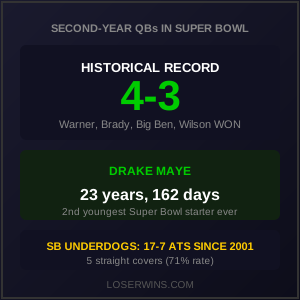
Drake Maye enters Super Bowl LX carrying a distinction that cuts two ways. At 23 years and 162 days old on February 8, the Patriots quarterback will become the second-youngest starter in Super Bowl history. The only QB younger? Dan Marino, who was 23 years and 127 days old when the Dolphins faced the 49ers in Super Bowl XIX.
Marino lost that game 38-16. He never made it back.
For bettors evaluating the Patriots as 4.5-point underdogs against Seattle, that historical echo matters. But the full picture of second-year quarterbacks in the Super Bowl tells a more nuanced story than the “Marino Curse” narrative suggests.
Second-Year Quarterbacks: A Mixed Record
Seven second-year quarterbacks have started the Super Bowl since the merger. Their record is 4-3, with the winners offering a compelling template for what Maye might accomplish.
The winners: Kurt Warner led the Rams to a championship in 1999. Tom Brady won his first ring with the Patriots in 2001. Ben Roethlisberger captured a title with the Steelers in 2006. Russell Wilson delivered Seattle’s first championship in 2013.
The losers: Marino fell to San Francisco in 1984. Colin Kaepernick came up short against Baltimore in 2012. Joe Burrow watched the Rams celebrate in 2022.
The pattern that emerges isn’t about age or experience. It’s about supporting cast and defensive strength. Warner, Brady, Roethlisberger, and Wilson all played on teams defined by dominant defenses or exceptional complementary talent. The losses came when second-year QBs were asked to carry their teams against superior opponents.
Why This Matters for Bettors
The public gravitates toward narratives. “Marino was the youngest and never won again” makes for compelling television. But it obscures the actual data: second-year quarterbacks win more Super Bowls than they lose.
New England’s path to this point mirrors the winning template. The Patriots went 14-3 behind a defense that carried the offense through difficult spots. In the AFC Championship, Maye completed just 10 of 21 passes for 86 yards in snowy conditions, but the defense held Denver to seven points.
That profile looks more like Brady in 2001 (when the Patriots defense dominated the Rams) or Roethlisberger in 2006 (when Pittsburgh’s defense smothered Seattle) than Marino in 1984 or Burrow in 2022.
The Underdog Streak Continues
Beyond the second-year quarterback angle, the Patriots benefit from a broader historical trend. Super Bowl underdogs have covered five consecutive games, going 4-1 outright during that stretch. Since 2001, underdogs are 17-7 against the spread in the Super Bowl, a 71% cover rate that dwarfs regular season norms.
The two-week gap before the Super Bowl amplifies public bias toward favorites. Casual bettors flood the market, and the spread often inflates beyond what sharp money considers justified. Early reports indicate public money is indeed flowing toward Seattle, with the line moving from the opening -3.5 to the current -4.5.
The Roethlisberger Precedent
If Maye wants a direct historical comparison, Roethlisberger’s Super Bowl XL offers the closest parallel. Big Ben was 23 years, 340 days old when Pittsburgh beat Seattle 21-10. He completed just 9 of 21 passes for 123 yards with two interceptions. The Steelers won anyway because their defense forced three turnovers and the running game controlled the clock.
Roethlisberger became the youngest quarterback to win a Super Bowl with that performance. Maye, at 23 years and 162 days, would surpass him by nearly six months if New England pulls the upset.
The contrarian case for the Patriots doesn’t require Maye to be spectacular. It requires him to avoid catastrophic mistakes while his defense contains a Seattle offense that has shown inconsistency down the stretch. Sam Darnold’s regular season QBR (56.0) was actually lower than his 2024 mark in Minnesota, suggesting the Seahawks’ success has been more about their dominant defense than offensive firepower.
Sportsbook Positioning
The betting market reveals interesting two-sided exposure. According to ESPN’s Super Bowl betting analysis, DraftKings has the Patriots as their largest Super Bowl futures liability after New England was available at 120-1 following Week 3. BetMGM, meanwhile, already paid out $1.4 million on a preseason Seahawks NFC futures bet and faces additional exposure if Seattle wins.
Both teams entered the season at +6000 to win the Super Bowl. According to SportsOddsHistory.com, this is the first Super Bowl since 2001 to feature a team with preseason odds that long. That 2001 game? The Patriots upset the Rams as 14-point underdogs.
What the Data Suggests
The “Marino Curse” makes for a good storyline, but the numbers tell a different story. Second-year quarterbacks are 4-3 in the Super Bowl. Underdogs have covered five straight and are 17-7 ATS since 2001. The Patriots fit the profile of second-year QB winners: young signal-caller supported by an elite defense.
None of this guarantees a New England victory. Seattle’s defense is legitimately dominant, and the Seahawks have earned their favorite status through consistent performance. But bettors who fade the Patriots based solely on Maye’s youth may be ignoring the more complete historical picture.
The youngest quarterback to start a Super Bowl never returned. The second-youngest to win one – Roethlisberger – won two more after that. History offers both narratives. The market will decide which one it believes.