
A Record $1.76 Billion on One Game
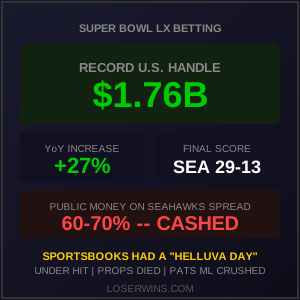
Americans legally wagered a record $1.76 billion on Super Bowl LX, according to the American Gaming Association. That’s a 27% jump from last year’s total. The global handle may have approached $4 billion when international markets are included.
The Seahawks beat the Patriots 29-13 as 4.5-point favorites. The public backed Seattle heavily. Sportsbooks cleaned up. And one holding penalty on a late Kenneth Walker touchdown run may have saved the entire industry from a catastrophic swing.
For contrarian bettors, the aftermath of Super Bowl LX offers more than a game recap. It’s a snapshot of where the money went, who got burned, and why the house almost always wins on the biggest betting day of the year.
Where the Public Money Landed
The betting public sided with Seattle across the board. At DraftKings, 60% of spread bets and 64% of the handle backed the Seahawks -4.5. The Westgate SuperBook in Las Vegas reported 70% of spread money on Seattle. Caesars, BetMGM, and Hard Rock Bet all told similar stories.
This time, the public got it right on the spread. Seattle covered comfortably, winning by 16 points. But the spread was only part of the picture. The real carnage happened on the moneyline, where high-profile bettors lined up to back the Patriots at +190 to +200 and watched it all evaporate.
The lesson for anyone following public betting trends: the crowd doesn’t always lose. Sometimes the favorite really is the better team. The contrarian edge comes from recognizing when the public is overpaying for an outcome, not from blindly fading every popular side.
Million-Dollar Bets That Went Wrong
The celebrity and high-roller money on the Patriots told its own story. Jim “Mattress Mack” McIngvale put $2 million on the AFC at +200 through Caesars before the conference championship games. Kendall Jenner wagered $1 million on the Patriots moneyline at +190 through Fanatics. BetMGM took a $1 million Patriots +4.5 bet hours before kickoff. Circa Sports absorbed two separate $1 million-plus Patriots moneyline wagers.
Every single one of those bets lost.
Combine that with the Patriots’ preseason future liabilities that sportsbooks had been sweating for months, and the result was a massive relief for the books. Circa’s Jeff Benson called it “a helluva day.” Derek Stevens, Circa’s owner, said it ended up being “one of the best Super Bowls that Circa Sports has ever had.”
On the winning side, Devin Booker collected $800,000 profit on a $1 million Seahawks -3.5 wager through Fanatics. A single BetMGM bettor who placed $50,000 preseason futures on the Seahawks at +6000 walked away with $3.77 million in net profit after hedging. And before the game even kicked off, one Caesars customer bet $253,000 on the coin toss landing heads — and profited $245,631.
The Under Crushed Prop Bettors
The total closed at 45.5 at most books. The final combined score was 42. Sharp bettors had been pushing the Under throughout the week, and they cashed.
But the broader impact was on prop markets. A low-scoring Super Bowl where the Patriots were shut out through three quarters meant most player prop Overs and Yes bets died on the vine. Receiver yardage Overs, anytime touchdown scorer parlays, multi-leg same-game parlays — the recreational bettor’s favorite Super Bowl wagers — all suffered in a game that was 12-0 heading into the fourth quarter.
Walker’s 49-yard touchdown run late in the game nearly changed everything. It would have pushed the total Over and cashed a flood of Walker props and parlays. A holding penalty wiped it off the board. Caesars’ Craig Mucklow admitted their “hearts were in our mouths” on the play. The flag held, and so did the sportsbooks’ profit margins.
The Broken Underdog Streak
Entering Super Bowl LX, underdogs of four or more points were 7-0 against the spread in the Super Bowl since 2007, per ESPN Research. The Patriots at +4.5 fit squarely into that profitable range. Contrarian bettors who followed that historical trend had reason to back New England.
It didn’t work. Seattle covered by 11.5 points, ending the streak at seven. The Seahawks’ defense sacked Drake Maye six times, forced three turnovers, and held the Patriots scoreless until the fourth quarter. Whatever statistical edge existed in the historical trend, it wasn’t enough to overcome a defensive performance that drew comparisons to the 1985 Bears.
Historical trends are real, and they matter. But they don’t override what’s happening on the field. A trend built on seven games across 18 years was always a small sample, and the Seahawks were clearly the superior team. Recognizing when to trust a trend and when to let it go is the harder skill.
A Record Handle, but Cracks in the Foundation
The $1.76 billion handle is a headline number that suggests a booming industry. Dig slightly deeper and the picture gets more complicated. Illinois, one of the largest legal betting markets in the country, has seen three consecutive months of 15% declines in the number of bets placed, according to the Sports Betting Alliance. The culprit: a per-bet fee of $0.25 to $0.50 that the state enacted last July, which led DraftKings and FanDuel to add $0.50 surcharges on every wager placed online in the state.
“When you have choice on a marketplace, you’re going to go where there is the best pricing,” Sports Betting Alliance President Joe Maloney told ABC7 Chicago. The concern is that fees push recreational bettors toward illegal offshore books or across state lines.
For now, the national numbers keep growing. But the Illinois experiment is a test case that other states are watching. If per-bet fees suppress handle in the country’s second-largest sports betting market, it could reshape how states approach the golden goose they’ve been chasing since the 2018 PASPA repeal.
What This Tells Contrarian Bettors
Super Bowl LX was a reminder that the biggest betting event of the year is also the hardest to find an edge. Record handle means record liquidity, and the lines are tighter than at any point during the season. The public had the Seahawks, the sharps had the Under, and both sides cashed.
The contrarian play — backing the Patriots +4.5 based on the historical underdog trend — lost. That happens. One game doesn’t invalidate a strategy built on decades of data. But it does reinforce a core principle of contrarian betting: the edge is in the process, not any individual result. The $1.76 billion wagered on Super Bowl LX mostly went to sportsbooks. That’s the house’s edge, magnified by the one game where everyone bets and nobody has an informational advantage.
The real opportunities for contrarian bettors tend to live in quieter corners of the calendar — midseason NFL games with lopsided public action, early-round March Madness matchups, Tuesday night NBA slates where the public hasn’t bothered to look. The Super Bowl is entertainment. The edge is everywhere else.