
The January Betting Surge
Something changes in the betting market every January. Millions of casual bettors who ignored NFL spreads all season suddenly want action on the playoffs. They download apps, make deposits, and start placing bets. Most of them back favorites.
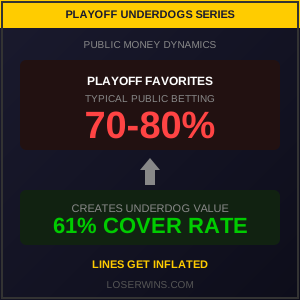
This isn’t speculation. Sportsbooks track ticket counts and handle percentages. During the regular season, the split between favorites and underdogs stays relatively balanced. But playoff games routinely see 70%, 80%, even 90% of tickets on the favored side. That imbalance creates opportunity.
Understanding why the public bets this way is the first step toward finding value on the other side.
The Psychology of Playoff Betting
Casual bettors gravitate toward favorites for predictable reasons. They want to root for the team they think will win. The playoffs feel like the time when the best teams are supposed to dominate. Nobody wants to cheer for an underdog in January and feel foolish when the favorite wins by 20.
There’s also a recency effect at work. The teams that earned top seeds did so by winning games in December. They’re fresh in everyone’s mind as winners. That momentum feels real, even when the numbers suggest the gap is smaller than it appears.
Media coverage amplifies these biases. Playoff weeks feature endless analysis of the favorites’ strengths, their path to the Super Bowl, their star players. Underdogs get mentioned as obstacles, speed bumps on the favorite’s journey. That framing shapes public perception and betting behavior.
How Sportsbooks Respond
Sportsbooks are businesses. They don’t set lines to predict outcomes with surgical precision. They set lines to balance action and guarantee profit through the vig.
When books know 80% of tickets will land on a favorite, they shade the line accordingly. A team that should be -6.5 might open at -7.5 because the book expects the public to bet them regardless. That extra point doesn’t reflect the team’s actual edge. It reflects anticipated public behavior.
This creates what contrarian bettors call “artificial value.” The underdog isn’t necessarily good. But the line has been pushed beyond fair value because of expected one-sided action. You’re not betting on the team. You’re betting against the market’s overreaction to public sentiment.
The Sharp Money Factor
Professional bettors understand these dynamics. They watch for discrepancies between ticket percentage and handle percentage. When 75% of tickets are on a favorite but only 55% of the money, that gap signals something important. Large bets are coming in on the underdog.
This “sharp money” often moves lines in the opposite direction of public action. A favorite might open at -7 and close at -6 despite heavy public betting. That reverse line movement tells you where the professional money landed.
Sharp bettors don’t have a crystal ball. They lose bets too. But they consistently identify spots where public perception has distorted lines beyond fair value. Playoff underdogs represent one of the most reliable such spots.
Why Playoffs Amplify the Effect
The regular season offers 272 games across 18 weeks. Casual bettors might dip in occasionally, but the volume spreads their influence thin. The postseason compresses everything. Thirteen games. Three weekends. Massive national attention on every matchup.
That concentration means casual money floods into a small number of games. Lines that might stay efficient during a random Week 11 game become distorted when every sports fan in America has an opinion and a betting app.
The effect is strongest in the Wild Card round, when six games happen in three days and everyone is paying attention. By the Conference Championships, the remaining teams are so evenly matched that lines tighten naturally. But those early-round games? That’s where the public creates the most value for contrarians.
The Favorite Fatigue Factor
There’s another element at play. Top seeds often enter the playoffs after grinding through a full regular season. They’ve taken hits, accumulated injuries, and dealt with the mental drain of expectations. Some have clinched early and coasted through meaningless late-season games.
Wild Card teams, by contrast, often fought for their playoff lives in Week 18. They’re battle-tested, desperate, and playing with house money. That intangible edge doesn’t show up in power rankings, but it can show up on the field.
The public sees a 14-3 team hosting a 10-7 team and assumes the outcome is obvious. The market prices in that perception. But the actual gap in performance, when these teams line up in January, is often smaller than the spread suggests.
2026 Wild Card Implications
This year’s bracket offers several spots where public money should inflate favorite lines. The Rams opened as 10.5-point favorites over the Panthers despite losing to Carolina 31-28 in Week 13. The public sees a Sean McVay squad with Super Bowl pedigree against an 8-9 division winner. The public bets the Rams.
The Bears and Packers sit near a pick’em, but Chicago drew the home field. Will the public remember Green Bay’s Week 14 win in Lambeau or Chicago’s Week 16 overtime win at Soldier Field? History says they’ll default to the more famous franchise.
The betting percentage data will tell the story as kickoff approaches. When one side draws 75%+ of tickets, the contrarian opportunity crystallizes. That’s not a guarantee of success. It’s a signal that the line might not reflect reality.
The Contrarian Edge
Fading the public isn’t about believing underdogs are better teams. It’s about believing the market has overcorrected. When casual money pushes a line two points beyond fair value, you don’t need the underdog to win. You need them to stay competitive.
A 10-point underdog only needs to lose by 9 or less. A 7-point underdog only needs to lose by 6 or less. Those margins are achievable far more often than the public’s one-sided action suggests.
The data supports this. Eight years of playoff results show underdogs covering at rates well above 50%. Not because they’re winning games outright. Because the lines were inflated by public perception, and the actual margins didn’t justify those inflated numbers.
Wild Card weekend starts Saturday. The public will place their bets. And somewhere on the other side of those lopsided ticket counts, value will emerge for those willing to take it.