
The Streak Is Over
Super Bowl underdogs had covered five straight. Four of the last five won outright. The trend was so dominant that sharp bettors at Circa put 72% of their moneyline dollars on the Patriots, and two seven-figure wagers landed on New England before kickoff.
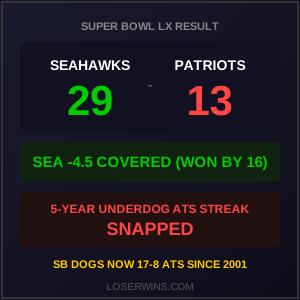
None of it mattered. The Seattle Seahawks dismantled the New England Patriots 29-13 at Levi’s Stadium on Sunday, covering -4.5 with ease and snapping the longest Super Bowl underdog ATS cover streak in history.
How Seattle Won and Covered
The Seahawks held the Patriots scoreless through three quarters. Read that again. In a Super Bowl featuring two top-four scoring offenses, one side put up zero points for 45 minutes of football.
Seattle’s “Dark Side” defense sacked Drake Maye six times and forced three turnovers — a fumble in the third quarter and two interceptions in the fourth. Maye finished 27-of-43 for 295 yards with two touchdowns and two interceptions, though the bulk of his production came in the fourth quarter as New England desperately tried to claw back from a 19-0 deficit.
The Seahawks’ offense wasn’t explosive either. Sam Darnold went 19-of-38 for 202 yards and one touchdown. But they didn’t need to be explosive. Kenneth Walker III rushed for 135 yards on 27 carries, earning Super Bowl MVP honors as the first running back to win the award since Terrell Davis in 1998. Kicker Jason Myers converted all five field goal attempts, setting a Super Bowl record.
The game was 9-0 at halftime. It was 12-0 entering the fourth quarter. By the time the Patriots finally scored on a 35-yard Mack Hollins touchdown reception, the outcome was already decided.
What the Betting Market Got Right
The public backed Seattle across the board. At DraftKings, 60% of bets and 64% of the handle were on the Seahawks -4.5. At the Westgate SuperBook, 70% of the money wagered on the spread landed on Seattle. At theScore Bet, 64% of spread bets favored the Seahawks.
This time, the public was right. Seattle won by 16 points, covering a 4.5-point spread by nearly 12 points. The total of 45.5 also went under (42 combined points), rewarding bettors who expected a defensive game.
For contrarian bettors who backed the Patriots based on the underdog ATS trend, the result serves as a reminder that trends are tendencies, not guarantees. Super Bowl underdogs had gone 17-7 ATS since 2001 entering this game. They’re now 17-8. Teams getting 3 or more points were 9-2 ATS since 2003. They’re now 9-3.
Where the Sharp Money Went Wrong
The most notable aspect of this Super Bowl from a contrarian perspective was the sharp-public split. At Circa, reportedly 72% of moneyline dollars were on the Patriots. Both disclosed seven-figure Super Bowl bets — Mattress Mack’s $2 million wager at +200 and a $1.1 million bet at Circa at +188 — were on New England.
It wasn’t a bad bet in a vacuum. The Patriots went from 60-1 preseason odds to the Super Bowl behind a 10-win improvement, the kind of value profile that contrarian bettors look for. Drake Maye had been the MVP runner-up during the regular season. The historical underdog ATS data was overwhelming.
But Seattle’s defense proved to be the equalizer that historical trends couldn’t account for. The Seahawks led the NFL in points allowed, third-down defense, and yards per rush allowed during the regular season. Those numbers translated directly to the biggest stage.
The Honest Takeaway
Contrarian betting works because public money inflates lines over time. The five-year underdog cover streak reflected real market inefficiency, with casual bettors pouring money on favorites and inflating spreads beyond fair value.
But one game is one game. A 17-8 ATS record for Super Bowl underdogs since 2001 still represents a 68% cover rate, which remains a historically strong edge. The streak ending doesn’t invalidate the underlying principle. It validates that variance exists in even the strongest trends.
Seattle was the better team on Sunday. Their defense was historically dominant. And the public, for once, correctly identified the right side. That happens sometimes. The data suggests it happens less often than people think, but it happens.
The 2025 NFL season is over. For contrarian bettors, the lesson from Super Bowl LX is the same one this site has always emphasized: follow the data, acknowledge the variance, and never treat any trend as a certainty.